

Trade War Jitters: USTR Signals President Trump Could Withdraw from USMCA Next Year
A senior official from the Office of the U.S. Trade Representative (USTR) has told Politico that President Donald Trump could decide to withdraw the U.S. from the United States-Mexico-Canada Agreement (USMCA) next year. This statement immediately resurrected trade uncertainty across North America, the region responsible for an estimated $1.8 trillion in annual trade between the three nations.
The USTR official noted that withdrawal is "always a scenario" because the President's core view is accepting only deals that are "a good deal." This aggressive stance, ahead of the USMCA's mandatory six-year Joint Review scheduled for July 2026, throws the future of North American economic integration into question and puts significant pressure on the Canadian and Mexican economies.
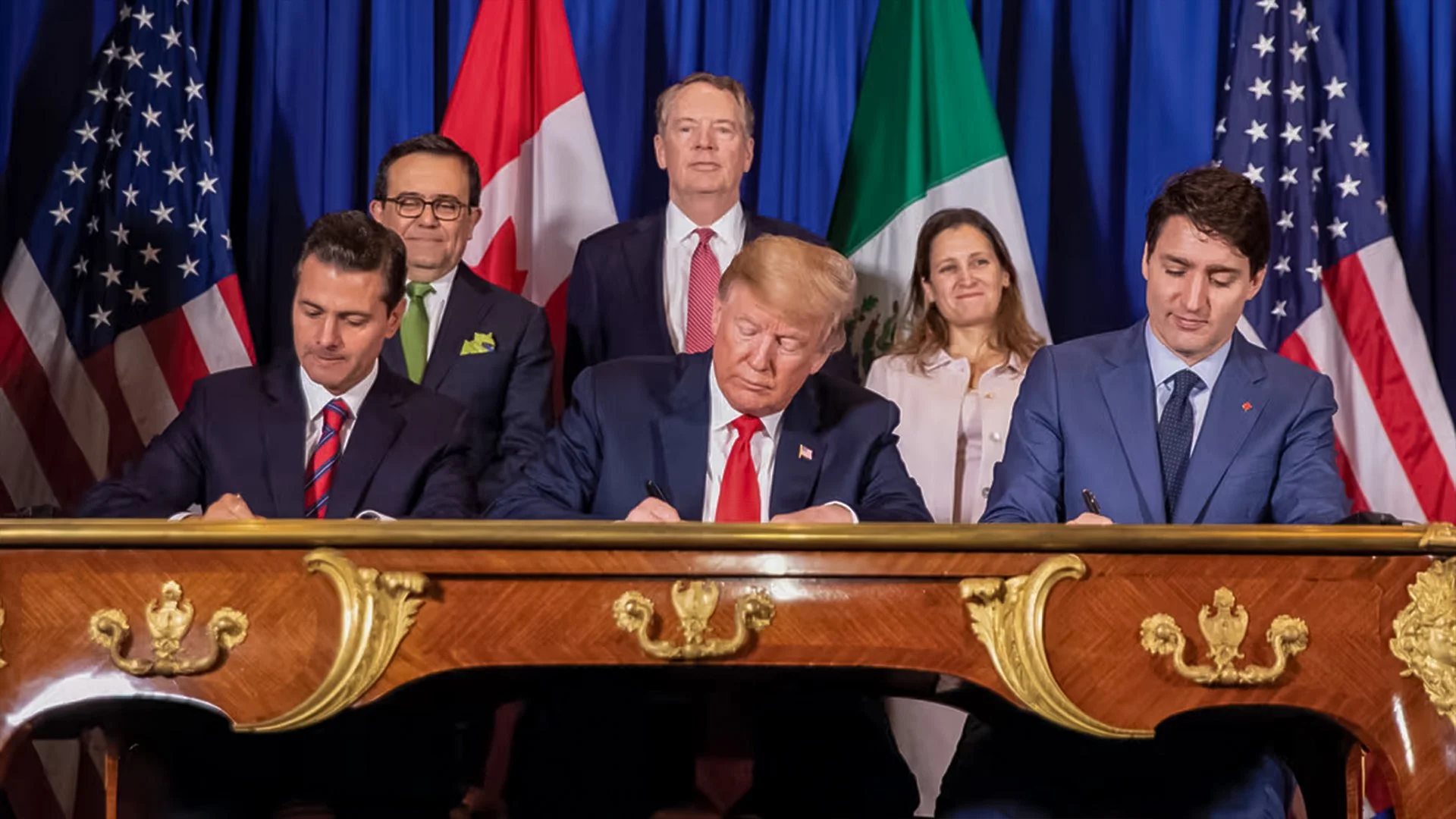
The Economic Cliff: What USMCA Withdrawal Means
The USMCA, which replaced NAFTA in 2020, modernized trade disciplines and created a highly integrated "Factory North America," particularly in the automotive sector. A U.S. withdrawal would not mean a complete halt to trade but would immediately subject goods trade to World Trade Organization (WTO) Most-Favored-Nation (MFN) tariffs.
1. Crippling Tariffs and Supply Chain Disruption
If the U.S. withdraws, Canada and Mexico would instantly face higher tariffs on exports to the U.S. Conversely, U.S. exports to Canada and Mexico would lose their duty-free status.
Sectoral Damage: The automotive sector would be hardest hit. Tariffs would be levied on intermediate goods crossing the border multiple times, potentially leading to disastrous cost increases and massive disruption for manufacturers like Ford, GM, and Stellantis, which rely on integrated North American supply chains.
Consumer Costs: Analysts estimate that tariffs would increase U.S. prices, potentially costing the typical U.S. household over $1,200 a year due to the higher cost of imported goods and retaliatory tariffs.
2. Loss of Predictability and Investment Halt
The primary benefit of USMCA is predictability and stability for investment. Withdrawal would eliminate preferential trade, increase customs barriers, and remove the crucial dispute resolution system, chilling Foreign Direct Investment (FDI) across the continent.
Canada and Mexico are particularly vulnerable, as over 75% of their exports depend on the U.S. market.


Forex Trading Volatility: Trading the Trade War Threat
The USTR's statement introduces a massive political risk premium into the Forex market, directly impacting the CAD and the MXN against the US Dollar (USD).
Trading the USD/CAD and USD/MXN Pairs
Trade policy is a primary driver for these currency pairs because the Canadian and Mexican economies are heavily dependent on trade with the U.S.
Immediate MXN and CAD Weakness: Any credible threat of USMCA termination or renegotiation is bearish for the Mexican Peso (MXN) and the Canadian Dollar (CAD). These currencies weaken against the USD as the threat of tariffs and trade collapse increases. The USD/MXN and USD/CAD pairs would likely spike, reflecting a flight from risk in Mexico and Canada.
Risk of Retaliation: Both Canada and Mexico would be compelled to implement targeted retaliation—meaning tariffs on U.S. exports. This would harm U.S. exporters and manufacturers, but economists agree that the initial damage to Canada and Mexico would be far greater due to their heavy reliance on the U.S. market.
For Forex Trading for Beginners, this is a classic example of how a geopolitical event (a trade threat) instantly creates fundamental risk (economic contraction and tariff shock) that can be traded via currency pairs. Institutions focused on Global Markets Eruditio monitor USTR statements closely because they often precede major trade actions that cause immediate and high volatility.
Navigating the Uncertainty
While the USMCA contains a clause allowing any party to withdraw with six months' notice (Article 34.6), Congress may also claim the need for a vote on such a move. Regardless of the legal outcome, the mere possibility of withdrawal introduces months of severe disruption and uncertainty for investors, workers, and businesses across North America.
The USTR's confirmation ensures that trade policy—and the fate of the USMCA—will remain the most dominant risk factor for North American currency pairs over the coming year.
Are You Positioned for the North American Trade Shock?
Trade threats are high-impact events that can generate sudden, volatile trends in the Forex market. Understanding the integrated nature of the USD, CAD, and MXN is crucial for profiting from policy risks.
Master the analysis of trade-driven volatility. Join the GME Academy community today and sign up for our FREE Forex Workshop to learn how to translate USTR warnings and trade policy shifts into executable Forex Trading strategies, giving you an edge in trading the USD/CAD and USD/MXN pairs.
