

The Infrastructure Freeze: Corruption Probe Clouds Philippine Recovery
The Philippine economy is entering 2026 facing a critical bottleneck. What began as a "flood control" controversy has evolved into a broader fiscal crisis, with ANZ Research warning that the country’s growth trajectory is now clouded by a massive slump in public spending and a breakdown in investor confidence.
At the GME Academy, we track "Fiscal Momentum" as a primary indicator of currency health. When the government—the country's largest spender—suddenly stops the flow of capital, the ripples are felt from the boardrooms of Makati to the households of Bicol.
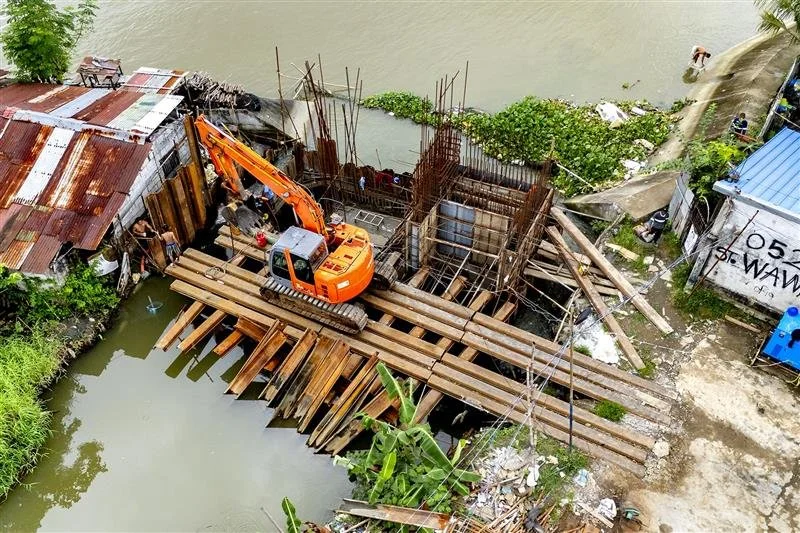
1. The $P1 Trillion Slump: A "Self-Inflicted" Tightening
The numbers released in early 2026 are stark. Government spending on infrastructure has not just slowed; it has plummeted.
The November Crash: Direct spending on infrastructure projects fell by 45.2% to just P48 billion in November 2025.
The 11-Month Tally: For the first nearly full year of 2025, total infra spending reached P991 billion, a 16% drop from the same period in 2024.
The 2001 Parallel: ANZ’s Sanjay Mathur notes that this mirrors the 2001 fiscal overhaul, which led to a "prolonged stretch of stagnant spending." The fear in 2026 is that the current graft probe will lead to a similar decade of underinvestment.
2. The "Flood Control" Fallout
The root of this paralysis is a sweeping investigation into anomalous flood control projects. The probe has implicated a wide net of high-ranking officials, including lawmakers, Cabinet members, and state engineers.
Non-Submission of Billings: Contractors, fearing they will be swept up in the graft investigation, have stopped submitting billings for completed work.
Procurement Paralysis: Government agencies have become extremely cautious, delaying new project approvals to ensure they aren't accused of bypassing anti-graft protocols.
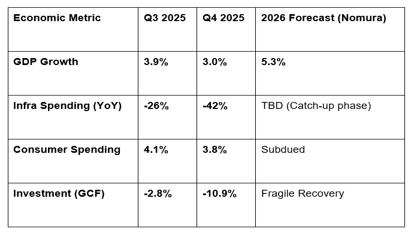
The 2025 Growth Hit: This "inadvertent fiscal tightening" shaved significant points off the GDP. Fourth-quarter growth for 2025 slumped to a post-pandemic low of 3%, dragging the full-year average down to 4.4%.
3. The Confidence Deficit
Infrastructure is more than just concrete and steel; it is a signal of "State Capacity." When governance issues arise, private money follows the public lead and retreats.
Investment Retreat: Gross capital formation (investment) crashed by 10.9% in Q4 2025.
Consumer Caution: Even household spending is cooling, rising only 3.8% as Filipinos grow more concerned about the country's economic direction.
Rare Export Resilience: In a strange twist for a domestic-driven economy, Net Exports was the only bright spot in late 2025. While positive, Mathur warns that relying on exports while the domestic engine is stalled is an "unstable" way to grow.


The GME Academy Analysis: "Trade the Second Half"
At Global Markets Eruditio, we anticipate that the first half of 2026 will be a "muddle-through" period.
Trader's Takeaway for 2026:
Wait for the Pivot: Nomura economists expect a turnaround only in the second half of 2026. This "catch-up spending" will likely be the primary catalyst for any sustainable rally in the Philippine Peso (PHP) or the PSEi.
Monetary vs. Fiscal: The Bangko Sentral ng Pilipinas (BSP) is expected to cut rates by another 50–75 basis points to offset the fiscal drag. For traders, this means a lower-yield environment for the Peso in the short term.
Watch the Audit Trail: The market is waiting for the 2026 National Budget to be fully deployed. If procurement doesn't resume by April, the government's downward-revised 5–6% growth target may still be too optimistic.
Join our FREE Forex Workshop at Global Markets Eruditio!
Is the "Infrastructure Slump" creating a buying opportunity for the Peso? We’ll show you how to read Philippine Treasury Yields and how to time your entries for the H2 2026 recovery.
