

The $92 Billion Powerhouse: Philippines Emerges as ASEAN’s Tourism Leader
The Philippine tourism sector has officially evolved from a recovery story into a regional economic juggernaut. According to the 2025 World Travel and Tourism Council (WTTC) Economic Impact Report (EIR), travel and tourism injected a staggering $91.8 billion into the Philippine economy, accounting for nearly 20% (19.9%) of the nation’s total GDP.
At the GME Academy, we view these figures as more than just travel stats—they are fundamental drivers of the USD/PHP exchange rate. When tourism contributes nearly a fifth of the economy, the "Greenback" isn't just coming in from OFWs or BPOs; it’s arriving through hotel bookings, local transport, and retail spending, providing a massive structural buffer for the Philippine Peso.

1. Leading the Pack: Outpacing Regional Giants
The WTTC report, presented by the Asian Development Bank (ADB) during the ASEAN Tourism Ministers' Meeting in Cebu City on January 30, 2026, placed the Philippines at the top of the regional leaderboard. The scale of the Philippine tourism economy now significantly exceeds several major neighbors:
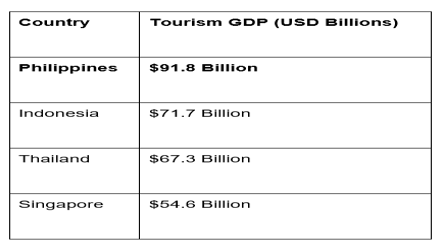
This lead is not just about the number of people landing; it’s about the value per visitor. As of September 2025, receipts per arrival in the Philippines reached $1,631, a sharp increase from $1,184 in 2019.
2. A Livelihood Engine: 11.2 Million Jobs
Tourism’s impact is felt most directly in the labor market. The sector now supports 11.2 million jobs, representing 23% of total national employment.
Regional Ranking: The Philippines is now the second-largest tourism employer in ASEAN, trailing only Indonesia in absolute numbers, but holding one of the highest employment shares relative to its total workforce.
Inclusivity: Tourism Secretary Christina Frasco highlighted that this growth is "people-centered," supporting everyone from mountain guides in Benguet to surf instructors in Siargao and transport providers in Cebu.
3. Strategic Shift: Revenue Over Volume
ADB Economist Sanchita Basu Das emphasized a critical shift in the ASEAN Tourism Action Plan 2026-2030: focusing on revenue per arrival.
The Opportunity: While Southeast Asia’s average receipt per arrival is $1,085, it still trails Northern Europe ($1,510) and North America ($2,165).
The Philippine Edge: With the Philippines already hitting $1,631 per visitor, the country is leading the regional move toward "high-value" tourism, which attracts visitors who stay longer and spend more on local experiences.
4. Connectivity: The Route to $100 Billion
At the closing of the 2026 ASEAN Tourism Forum (ATF) in Cebu, the government reaffirmed its commitment to "Route Development."
New Gateways: Cebu has recently launched 13 new international routes, many of which connect directly to ASEAN neighbors. Manila has seen an additional 23 international flight expansions.
Intra-Regional Travel: The ADB is pushing to increase the share of intra-ASEAN travelers from 38% to 45% by 2030, reducing the region's reliance on volatile long-haul markets like Europe or North America.


The GME Academy Analysis: A "Long" Position on the Peso?
At Global Markets Eruditio, we teach that a $91.8 billion industry acts as a constant "bid" for the Peso.
Dollar Liquidity: High receipts per arrival mean more USD is being converted into PHP daily.
Current Account Stability: Tourism is an "Invisible Export" that helps narrow the trade deficit.
Forward Guidance: As the Philippines prepares to lead the ASEAN Chairship in 2026, the continued expansion of air routes is a "Bully Signal" for the Peso's long-term resilience.
Are You Trading the "Tourism Dividend"?
As the Philippines hits record-breaking tourism revenues, the USD/PHP is finding a new fundamental anchor. Don't trade on old 2024 data when the 2026 landscape has completely shifted.
Join our FREE Forex Workshop
Learn how to track "High-Value Tourism" data. We’ll show you how to use ADB and WTTC reports to predict the Peso's seasonal peaks and how to stay ahead of the next major move in the Philippine markets.
