

The Return of "Tariff Man": Trump Claims 78% Trade Deficit Reduction as Surplus Looms
In a bold proclamation that has sent shockwaves through global markets, President Donald Trump announced on Wednesday, February 18, 2026, that his administration’s aggressive tariff policy has slashed the U.S. trade deficit by a staggering 78%. Taking to social media, the President declared that the United States is on track to enter "positive territory"—a trade surplus—within the year, a feat not seen in over half a century.
"THE UNITED STATES TRADE DEFICIT HAS BEEN REDUCED BY 78% BECAUSE OF THE TARIFFS," Trump wrote, thanking the public for their attention to what he describes as a historic economic pivot.

1. The Numbers Behind the Claim: Surplus in Sight?
While the 78% figure has sparked intense debate among economists, real-time data from late 2025 and early 2026 provides some context for the President's optimism.
The Monthly Swing: In October 2025, the U.S. trade deficit narrowed to $27.6 billion, an 80% drop from the record-high $140.5 billion seen in March 2025 (a spike caused by importers "front-loading" goods before tariffs took effect).
December Projections: Official data due on Thursday, February 19, 2026, is expected to show a monthly trade surplus of roughly $55.5 billion. If confirmed, this would be the first monthly surplus for the United States since 1975.
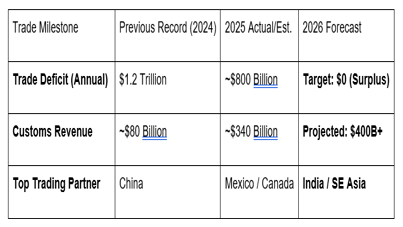
Annual Outlook: Despite the monthly gains, the total 2025 trade deficit is still expected to land around $800 billion. While this is a significant reduction from the $1.2 trillion record in 2024, the "positive territory" Trump refers to is likely a projection for the 2026 fiscal year.
2. "Liberation Day" and the Reciprocal Strategy
The backbone of this shift is the "Liberation Day" tariffs introduced on April 2, 2025. These measures applied near-universal tariffs ranging from 10% to 50% on hundreds of countries.
The Negotiation Pivot: Following the initial shock, the administration negotiated "reciprocal trade deals" with partners like India, Bangladesh, and Argentina. These deals typically lower the tariff rate in exchange for increased purchases of American energy, agriculture, and tech.
The China Decoupling: Imports from China saw a precipitous drop, falling to $288 billion (Jan–Nov 2025) compared to $401 billion the previous year. However, analysts note that much of this volume has shifted to "friendly" hubs in Southeast Asia and Mexico.
3. The Economic "Cancer" or "Miracle"?
Critics and supporters remain deeply divided on the long-term health of the "Tariff Economy."
The Cost to Consumers: A recent Federal Reserve study found that American businesses and consumers bore nearly 90% of the cost of the 2025 tariffs. While the deficit is shrinking, prices for imported electronics and automobiles remain elevated.
Revenue Surge: On the flip side, the U.S. Treasury reported a 318% increase in customs duties, providing a massive influx of non-tax revenue that is helping to offset the federal budget deficit.


GME Academy Analysis: "Trading the Trade War"
At Global Markets Eruditio, we are tracking the "Dollar Paradox"—where the U.S. Dollar is weakening despite a shrinking trade deficit.
Trader's Takeaway for February 2026:
Domestic Rotation: The "One Big Beautiful Bill Act" (OBBBA) incentivizing domestic production is making U.S. Industrial and Small-Cap (Russell 2000) stocks more attractive than global multi-nationals.
Inflation Hedge: As tariffs keep import prices high, "near-shoring" plays in Mexico and Canada remain the safest bet for supply-chain stability.
The "Mission Accomplished" Risk: Markets should watch the February 19 Trade Data release. If the surplus misses expectations, the "78% reduction" claim may be viewed as a peak, leading to a short-term correction in the Dow.
Join our FREE Macro Workshop at Global Markets Eruditio! Is a U.S. trade surplus bearish for global growth? We’ll break down the 2026 Reciprocal Trade Framework and show you how to trade the "National Emergency" volatility.
