

Labor Market Chill: U.S. Jobless Claims Hit 2026 Low as Hiring Remains Frozen
The U.S. labor market flashed a signal of stabilization today, February 19, 2026, as initial jobless claims plunged to their lowest level of the year. However, beneath the headline drop lies a complex "low-hire, low-fire" equilibrium that continues to challenge the Federal Reserve's path toward interest rate cuts.
In the week ending February 14, seasonally adjusted initial claims fell to 206,000, a significant decrease of 23,000 from the previous week’s revised level. This figure beat economist expectations of 225,000 by a wide margin, suggesting that while the "hiring recession" of 2025 lingers, the wave of mass layoffs has largely stalled.

1. The "Low-Fire" Reality: Initial Claims Plunge
The sharp decline in new filings marks a retreat from the January peak of 232,000. Economists note that while companies are hesitant to hire due to ongoing tariff-driven inflation and AI-driven restructuring, they are equally reluctant to let go of existing talent.
Revision Watch: The previous week's claims were revised up slightly to 229,000, making the 23,000-claim drop even more pronounced.
4-Week Average: The more stable four-week moving average also edged lower to 219,000, confirming a cooling trend in total weekly job separations.
Year-over-Year: On an unadjusted basis, initial claims (207,694) are down nearly 7% compared to the same week in 2025, signaling a more stable floor for the labor market this year.
2. The "Low-Hire" Trap: Continuing Claims Edge Higher
While fewer people are losing their jobs, those who are unemployed are finding it increasingly difficult to get back to work.
Continuing Claims: The number of people receiving ongoing unemployment assistance rose to 1.869 million for the week ending February 7.
Hiring Freeze: Economists point to a "lopsided" growth pattern where healthcare and social assistance account for the majority of new roles, while financial services and federal government sectors continue to shed positions.
Median Duration: The average length of unemployment has hit nearly 21 weeks, forcing many mid-career professionals to consider steep pay cuts just to re-enter the workforce.
3. Regional Breakdown: The State of the States
The "Insured Unemployment Rate" remained steady at 1.2%, but regional disparities highlight where the industrial and tech-heavy economies are feeling the most pain.
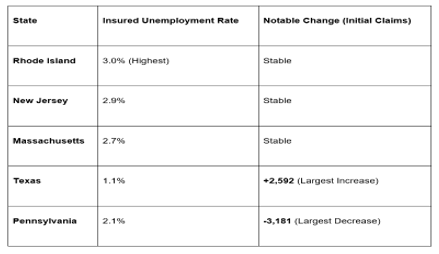
The Texas Surge: Despite a strong energy sector, Texas saw the largest raw increase in new filings (+2,592), likely tied to ongoing volatility in trade-exposed manufacturing.
The Northeast Strain: High-cost states like Rhode Island and New Jersey continue to lead the nation in insured unemployment rates, reflecting a slower recovery in the white-collar and service sectors.


GME Academy Analysis: "Breakeven Employment"
At Global Markets Eruditio, we believe the labor market is currently in a state of "fragile stability." The January surge in hiring (130k) was a positive surprise, but it follows massive downward revisions to 2025 data.
Trader's Takeaway for February 2026:
Fed "Long Pause": The drop in initial claims gives the Federal Reserve more breathing room to keep rates elevated. With the labor market "stabilizing" at a low-hire level, there is no immediate pressure on the Fed to cut rates until inflation confirms a downward trend toward 2%.
Treasury Yields: The 10-year Treasury yield rose to 4.107% following the news, as markets priced out a March rate cut.
Sector Play: Focus on Healthcare and Construction (AI infrastructure buildout), as these remain the only true "growth engines" in the 2026 job market.
Join our FREE Macro Workshop at Global Markets Eruditio!
Is the "Hiring Recession" finally over? We’ll break down the February Non-Farm Payrolls Outlook and show you how to trade the USD response to the next big data print.
