

The Great Diversification: Evaluating the EUR and CNY as Reserve Alternatives
In February 2026, the global financial architecture is undergoing a subtle but undeniable shift. While the US Dollar (USD) remains the dominant reserve currency (at roughly 57–58% of global reserves), "Dollar Fatigue" has prompted central banks and institutional investors to look toward the Euro (EUR) and the Chinese Yuan (CNY/RMB) as strategic alternatives.
At the GME Academy, we see this as a pivot from a unipolar world to a multipolar monetary system. However, choosing an alternative isn't just about picking a different paper currency; it's about weighing liquidity and transparency against technological innovation and geopolitical reach.
1. The Euro (EUR): The "Traditional" Contender
The Euro remains the most logical alternative for those seeking a "USD-lite" experience. It is the second most used currency globally, backed by a sophisticated (though complex) legal and democratic framework.
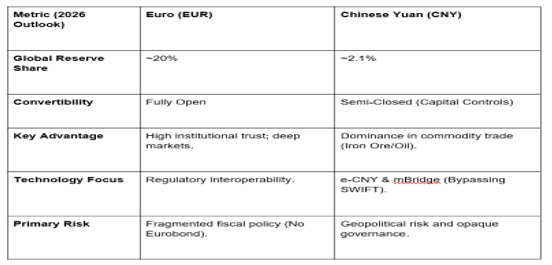
Status in 2026: The Euro currently accounts for roughly 20% of global reserves. It is the "default" alternative for traditional Western-aligned economies.
The "Stability" Play: Unlike the USD, which has faced questions regarding Federal Reserve independence and tariff volatility in late 2025, the European Central Bank (ECB) is viewed as a pillar of technocratic stability.
Digital Integration: The Digital Euro project has moved into hybrid pilot stages, focusing on cross-border interoperability with hubs like Singapore to reduce settlement times.
The Catch: The lack of a unified "Eurobond" market means the Eurozone still lacks a single, deep pool of risk-free assets that can match the size of the US Treasury market.
2. The Chinese Yuan (CNY): The "Technological" Challenger
Under President Xi Jinping’s "Powerful Currency" initiative—cemented in the 15th Five-Year Plan (2026–2030)—China is aggressively positioning the Renminbi as the reserve currency of the "Global South."
Status in 2026: Despite China’s economic size, the Yuan still holds a modest 2.1% share of global reserves. However, its share of global payments (SWIFT data) hit a record 4.8% in December 2025.
The "Digital First" Strategy: China leads the world in CBDC adoption. The e-CNY has processed over $2.4 trillion in transactions and was recently reclassified as "Digital Deposit Money," allowing it to bear interest—a crucial step for institutional adoption.
Project mBridge: This multi-central bank platform has processed over $55 billion in cross-border settlements, with the e-CNY accounting for 95% of the volume. It allows countries like Saudi Arabia and the UAE to settle trade without using the USD-based SWIFT system.
The Catch: Capital Controls. Beijing remains reluctant to fully open its capital account, fearing that total convertibility could lead to destabilizing capital flight. This creates a "trust gap" for central banks that need to be able to exit positions quickly during a crisis.
3. Comparative Analysis: EUR vs. CNY
4. The Rise of "Fragmented" Reserves
In 2026, central banks will no longer be looking for a single replacement for the Dollar. Instead, they are practicing fragmented diversification.
Gold as the Third Alternative: Since gold hit all-time highs in early 2026, many banks see it as a "neutral" reserve that complements EUR or CNY holdings.
Commodity-Linked Settlement: We are seeing more "Yuan-for-Oil" or "Yuan-for-Iron-Ore" deals. While this doesn't make the Yuan a global reserve yet, it creates a circular ecosystem where the CNY is used as a functional "Trade Currency."


The GME Academy Analysis: "Portfolio Positioning"
At Global Markets Eruditio, we advise our students to watch the USD/PHP exchange rate through the lens of these alternatives.
Trader's Takeaway for 2026:
Euro/Yuan Correlation: When the USD weakens, the EUR often gains on "stability" flows, while the CNY gains on "trade" flows.
Watch the March NPC: China’s National People's Congress in March 2026 will unveil the next phase of current account reforms. If they loosen capital controls even slightly, expect a massive institutional bid for the Yuan.
Diversification for Retail: Even small-scale traders are beginning to hold "Digital Euro" or "e-CNY" proxies (like stablecoins or multi-currency accounts) to hedge against USD-specific volatility.
Join our FREE Forex Workshop at Global Markets Eruditio!
Is the Dollar’s reign coming to an end? We’ll analyze the SDR (Special Drawing Rights) basket and show you how to trade the EUR/USD and USD/CNH pairs as the world moves toward a multipolar financial order.
