

The Hardest Cut: When to Stop Trading a Strategy
In the trading world of 2026, the biggest threat to your capital isn't necessarily a "bad" trade—it's the Zombie Strategy. This is a system that once worked beautifully but has since lost its "edge" due to shifts in market regimes, high-frequency algorithms, or central bank pivots.
At the GME Academy, we believe that knowing how to trade is only half the battle. The other half is knowing when to take your strategy "behind the barn" and retire it. As of February 10, 2026, with AI-driven volatility reaching new peaks, the window for strategy decay has shortened significantly.
1. The Warning Signs of Strategy Decay
Strategies rarely "break" overnight; they fade. Like a battery losing its charge, the signals become noisier and the profits smaller.
Lower Profit Factor: If your system historically returned $2.00 for every $1.00 risked (Profit Factor of 2.0) but has struggled to maintain a 1.1 over the last 100 trades, the "edge" may be arbed away by institutional players.
Correlation Convergence: In 2026’s interconnected market, if your "uncorrelated" strategies (e.g., trading Gold vs. trading the Nikkei) start moving in perfect lockstep, your diversification is gone, and your risk is doubled.
The "News Gap" Failure: If your strategy used to survive high-impact news like the NFP or CPI but now consistently gets "slipped" or "hunted" during these events, the market’s liquidity profile has likely changed beyond your system's parameters.
2. Maximum Drawdown vs. Statistical Deviation
Every strategy has a "Maximum Drawdown" (MDD)—the biggest peak-to-trough loss in its history. But relying on MDD alone is dangerous.
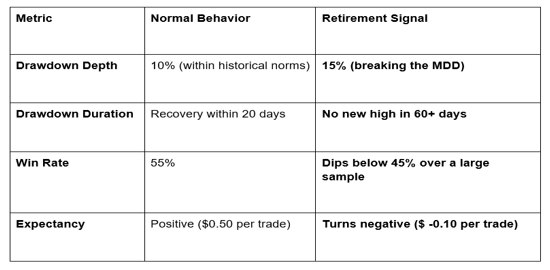
GME Rule of Thumb: If your strategy enters a drawdown that is 1.5x larger than its historical maximum, stop trading it immediately. The market regime has changed, and your backtest is no longer valid.
3. Recognizing "Regime Shifts" in 2026
In the 2026 market landscape, "Regime Shifts" are the primary strategy killers. A regime shift occurs when the underlying "physics" of the market changes.
From Trending to Mean-Reverting: A trend-following system (like a 50/200 EMA cross) will be "chopped to death" if the market enters a wide, volatile range.
The "Volatility Floor": In early 2026, the VIX (Volatility Index) has established a higher floor due to geopolitical fragmentation. Strategies designed for the "Quiet Era" of the early 2020s are often too sensitive for this new, louder environment.
Policy Pivots: If your strategy was built on "Cheap Money" (low interest rates), it will structurally fail in a "Higher for Longer" inflation regime
4. The "Incubation" and "Retirement" Process
At Global Markets Eruditio, we suggest a "Bench System" for your strategies.
The Active Roster: Your 2-3 best-performing strategies.
The Bench (Demo/Paper): New strategies being "incubated" or old strategies that are currently in a drawdown and being monitored for recovery.
The Retirement Home: Strategies that have failed their statistical checks. Do not delete them—keep them to study why they failed.

The GME Academy Analysis: "Kill Your Darlings"
The hardest part of trading is the emotional attachment to a strategy that used to make you money. We call this "Strategy Sunk Cost."
Trader's Takeaway for 2026:
Use a "Kill Switch": Set an absolute dollar amount. If the strategy loses $X, it is turned off. No exceptions. No "one more trade."
Review Every 100 Trades: Do not judge a strategy on a bad week. Judge it on a statistically significant sample. For most day traders, 100 trades is the "truth window."
USD/PHP Context: If you are trading a Carry Trade strategy (earning interest on the Peso), be ready to kill the strategy if the BSP (Bangko Sentral ng Pilipinas) signals an aggressive rate-cutting cycle. The fundamental "carry" edge can vanish in a single press conference.
Join our FREE Forex Workshop at Global Markets Eruditio!
Is your strategy broken or just in a "hiccup"? We’ll show you how to perform a Monte Carlo Simulation on your trading data to see if your current losses are a statistical certainty or a sign of total strategy failure.
