

The OPEC Chessboard: Production Decisions and Oil-Currency Impact
In the complex financial ecosystem of February 10, 2026, few organizations hold as much power over your trading screen as OPEC+. While we often think of oil as a physical commodity, for a Forex trader, it is a "liquidity pump" that can strengthen or weaken currencies in a matter of seconds.
Following the high-stakes January 4, 2026, virtual meeting, where the alliance reaffirmed its decision to pause production increases through the first quarter, the relationship between "black gold" and the global currency market has entered a new, more sensitive phase.
1. The 2026 Strategic Pivot: Volume vs. Price
OPEC+ is currently navigating a "Supply Glut" era. According to the IEA’s January 2026 report, the world is facing a massive surplus of roughly 3.8 million barrels per day (bpd)—about 4% of total global demand.
The Decision: Core members like Saudi Arabia and Russia have frozen their plan to return 1.65 million bpd to the market until at least April 2026.
The Logic: By "pausing" the tap, OPEC+ is trying to prevent Brent Crude from crashing below the $55–$60 mark. For traders, this creates a "floor" under the market, but also a "cap" on gains, as any price surge would likely be met with an immediate reopening of the taps.
2. The Petro-Currency Reaction: CAD, NOK, and BRL
When OPEC+ speaks, the "Petro-Currencies" (economies that rely heavily on oil exports) react first.
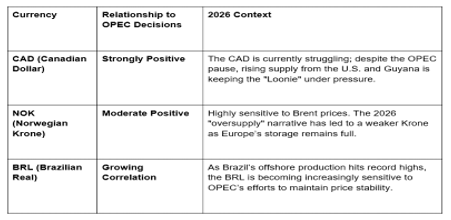
GME Pro Tip: Keep an eye on the USD/CAD pair during OPEC press conferences. If the group announces a "deeper cut," the CAD often spikes instantly, causing the pair to drop.
3. The "Dollar-Oil" Negative Correlation
The most famous relationship in Forex is the inverse link between the US Dollar (USD) and Crude Oil. Since oil is globally priced in Greenbacks:
When the USD strengthens: Oil becomes more expensive for non-US buyers, leading to lower demand and lower prices.
When OPEC+ cuts supply: Oil prices rise, which can actually lead to a weaker USD in the short term as the "Terms of Trade" shift in favor of exporters.
The 2026 Twist: In the current environment, this correlation is "noisy." Because the US is now a top-tier energy exporter, high oil prices no longer hurt the US economy as much as they did in the 2000s. This has made the DXY (Dollar Index) more resilient even when oil prices tick upward.
4. Impact on the Philippine Peso (USD/PHP)
For a net importer like the Philippines, OPEC+ decisions are a direct driver of Imported Inflation.
The "Energy Tax": When OPEC+ successfully keeps prices near $65, the Philippines must spend more US Dollars to buy the same amount of fuel. This increases the demand for USD in the local market, putting upward pressure on the USD/PHP exchange rate.
Trade Balance: In early 2026, the BSP (Bangko Sentral ng Pilipinas) highlighted that stable (or lower) oil prices are the "primary tailwind" for the Peso, helping to keep the exchange rate from breaking the psychological ₱58.00 barrier.


The GME Academy Analysis: "Trading the Meeting"
At Global Markets Eruditio, we analyze OPEC+ meetings as "binary events"—much like an interest rate decision.
Trader's Takeaway for 2026:
Watch the "Compensation" Data: OPEC+ is currently cracking down on members who overproduced in 2025 (like Iraq and Kazakhstan). If these countries actually comply with "compensation cuts," it could provide a surprise boost to oil prices and petro-currencies.
The Q2 Rebalancing: The next major "market-moving" meeting is set for March 2026. This is when the alliance will decide whether to finally release the "frozen" barrels. If they do, expect a sharp sell-off in the CAD and a relief rally for the JPY and PHP.
Volatility Management: Oil-driven currency spikes can be violent. We recommend traders use ATR (Average True Range) indicators to set wider stops during OPEC meeting weeks.
Join our FREE Forex Workshop at Global Markets Eruditio!
Is the "Petro-Dollar" era ending or just evolving? We’ll break down the USD/CAD and USD/NOK correlations and show you how to use the OPEC Monthly Oil Market Report (MOMR) to stay one step ahead of the trend.
