

The Race to Zero: Latency, Speed, and Co-Location in FX Trading
In the fast-moving markets of 2026, the difference between a winning trade and a "missed fill" is no longer measured in seconds—it is measured in nanoseconds. For institutional and retail traders alike, the trifecta of Latency, Speed, and Co-location has become the invisible foundation of the modern trading stack.
At the GME Academy, we teach our students that while strategy is king, execution is the kingdom. If your connection is too slow, even the most brilliant AI-driven strategy will fail to capture the price you see on your screen.
1. Understanding the "Latency Stack"
In Forex, Latency is the time delay between sending a trade order and receiving confirmation from the broker. This "round-trip time" (RTT) is affected by physical distance, network quality, and hardware processing.
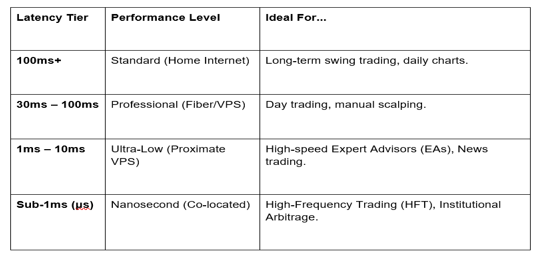
The 2026 Reality: Research shows that every additional 100ms of latency can slash HFT win rates by up to 4.2 percentage points. For scalpers targeting 1–3 pips, a 50ms delay can turn a profit into a loss due to Slippage (the difference between the expected price and the actual execution price).
2. Co-Location: Eliminating the "Distance Tax"
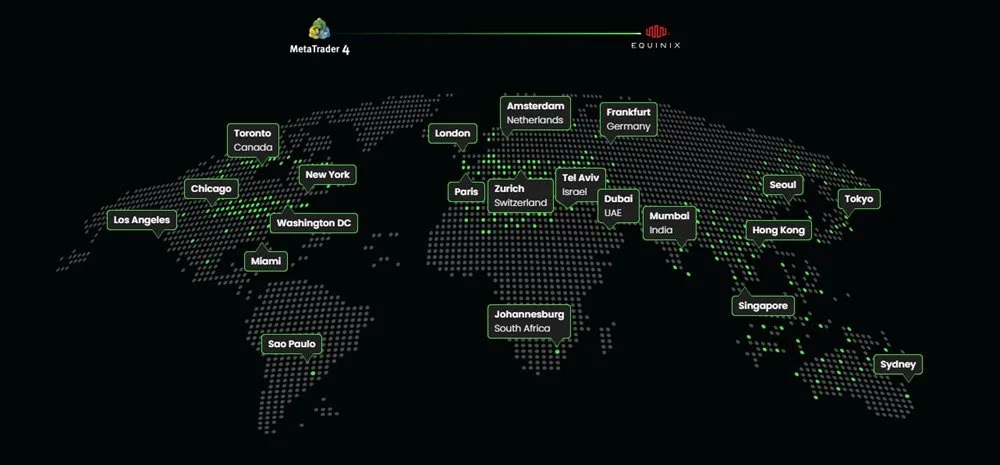
Data travels through fiber-optic cables at roughly the speed of light, but it still takes time to cross continents. Co-location is the practice of placing your trading server in the same physical data center as your broker’s trade-matching engine (e.g., Equinix LD4 in London or NY4 in New York).
Why Co-location is Essential in 2026:
Proximity: If your server is in the same building as the broker, the "travel time" for your data drops from 100ms to less than 1ms.
Cross-Connects: Traders use direct fiber-optic "cross-connects" to bypass the public internet entirely. This treats data as pure electrical impulses, reducing "jitter" (variation in latency).
Fiber Innovations: The gold standard has shifted from traditional silica glass to hollow-core fiber, where light travels through air at near-vacuum speeds, shaving additional microseconds off the Atlantic "NY-LON" corridor.
3. Specialized Hardware: FPGAs and Cache Optimization
In 2026, the "speed arms race" has moved from software to hardware.
FPGA (Field-Programmable Gate Arrays): High-level firms now use FPGAs instead of standard CPUs. These are chips programmed specifically for one task: execution. FPGAs can process trade logic in under 200 nanoseconds, bypassing the delays inherent in traditional operating systems.
L3 Cache Packing: Modern trading code is now designed to fit entirely within the CPU's L3 cache. This prevents the processor from having to "reach out" to slower RAM, which can be 10x slower than cache access.
4. Impact on Market Microstructure
Speed doesn't just help individual traders; it changes how the market works.
Tighter Spreads: When market makers are co-located and fast, they can update their quotes instantly. This competition leads to tighter bid-ask spreads for everyone.
Price Discovery: Faster systems incorporate new information (like news releases) into the price faster, making the market more efficient.
Queue Priority: Most exchanges operate on a "First-In, First-Out" (FIFO) basis. If two traders try to buy at the same price, the faster system gets the fill, while the slower one sits in the "queue" and may never be executed.

The GME Academy Analysis: "Do You Need Nanoseconds?"
At Global Markets Eruditio, we believe in right-sizing your technology.
Our Advice for 2026 Traders:
Retail Scalpers: You don't need a million-dollar FPGA setup. A high-quality Forex VPS located in New York or London will give you sub-10ms latency, which is more than enough for 99% of retail strategies.
Manual Traders: For you, reliability is more important than raw speed. Ensure your internet connection is stable so you don't experience "hangs" during high volatility.
Avoid "Cloud Lag": While public clouds (AWS/Google) are great for backups, they often introduce "virtualization lag." For execution, always prefer a dedicated server with bare-metal performance.
Join our FREE Forex Workshop at Global Markets Eruditio!
Want to test your current latency? We’ll show you how to benchmark your broker and set up a low-latency VPS to ensure you never get "slipped" again during the NFP or Central Bank releases.
