

The Price of Fear: Understanding the "War Premium" in Safe Havens
In the financial markets of 2026, "Safe Haven" is no longer just a label for boring, stable assets. It has become the most active theater of trade. When geopolitical tensions escalate—be it through kinetic conflict, trade wars, or "weaponized" financial systems—investors pay a War Premium. This is the extra "insurance cost" baked into the price of assets like Gold, the US Dollar, and the Swiss Franc.
At the GME Academy, we teach that a War Premium isn't based on earnings or interest rates; it is based on the probability of the unthinkable. When unpredictability rises, fundamental analysis takes a back seat to survival.
1. What is a "War Premium"?
A War Premium (or Geopolitical Risk Premium) is the surge in price that occurs when market participants prioritize capital preservation over profit maximization.
The Mechanism: Investors sell "Risk-On" assets (stocks, emerging market currencies, high-yield bonds) and flood into "Risk-Off" vehicles.
The 2026 Shift: In early 2026, the premium is no longer just about bombs and missiles. It has expanded to include Trade War Premiums—where tariffs act as a macro shock, reshaping supply chains and raising insurance costs globally.
2. The Safe-Haven Hierarchy in 2026
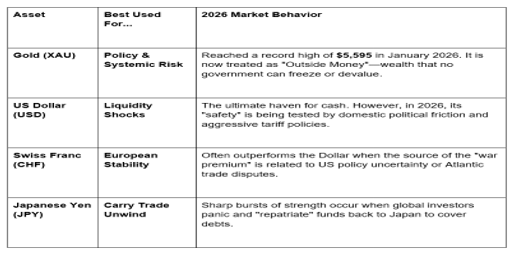
Not all safe havens react the same way to a war premium. Depending on the nature of the conflict, the market chooses its "weapon of choice":
3. The "Credibility Hedge": Gold's New Role
As of February 10, 2026, the War Premium in Gold has undergone a structural change. It is no longer just hedging inflation; it is hedging institutional reliability.
Geopolitical Fragmentation: As nations increasingly use financial infrastructure as a policy tool (sanctions, asset freezes), neutral assets like Gold become more valuable.
The 2-5% Rule: Academic and market research suggests that a typical geopolitical shock adds 2% to 5% to the price of gold almost instantly. In 2026, with simultaneous risks in the South China Sea, Venezuela, and Eastern Europe, these effects are compounding beyond historical norms.
4. How the Premium "Deflates"
A War Premium is notoriously difficult to maintain. It is a "fear-driven" bid that eventually faces the reality of supply and demand.
The "News Fatigue" Effect: If a conflict becomes a long-term "grind" rather than a sharp escalation, the premium slowly leaks out as markets get used to the "new normal."
The Reversal: For example, in early February 2026, gold saw a sharp pullback from its highs as Middle East tensions showed signs of easing following talks in Oman. This "deflation" of the risk premium can be as violent as the initial spike.
The GME Academy Analysis: "Trading the Premium"
At Global Markets Eruditio, we advise traders to treat the War Premium as a volatility multiplier, not a guaranteed trend.
Trader's Takeaway for 2026:
Use Dynamic Stops: In 2026, daily gold swings of $150–$200 have become routine. Traditional 30-pip stop losses will be "hunted" by volatility. Use ATR (Average True Range) to set wider, more realistic protection.
Watch the USD/JPY: This pair is your "Fear Barometer." If Gold is rising but USD/JPY is falling sharply, the market is signaling a true systemic crisis, not just a temporary news spike.
Manage "Headline Risk": In a high-premium environment, a single social media post from a world leader can move the market more than a Central Bank decision. Never trade without a "Kill Switch" for your automated systems.
Join our FREE Forex Workshop at Global Markets Eruditio!
Is the War Premium about to pop or propel higher? We’ll analyze the Geopolitical Risk Index (GPR) and show you how to position your portfolio to survive—and profit—during the most volatile year in recent history.
