

The Imbalance Magnet: Trading Fair Value Gaps (FVG) and the Smart Money Footprint
The Fair Value Gap (FVG), often synonymous with a price imbalance or inefficiency, has become a cornerstone of modern Forex Trading strategies, particularly within the Smart Money Concepts (SMC) framework. These three-candle patterns reveal where aggressive institutional order flow overwhelmed liquidity, creating a "vacuum" that the market often revisits. Understanding this inefficiency is key to predicting high-probability retracement and continuation zones.
Fair Value Gaps (FVGs) are not mere chart gaps that appear between trading sessions; they are unique price inefficiencies created during active market hours by sharp, impulsive buying or selling pressure. In an efficient market, every buyer is met by a seller, resulting in overlapping candle wicks. When large institutions—banks or hedge funds—enter the market with massive orders, this balance is broken, leaving a portion of the price range untraded and an imbalance that acts as a magnetic target for future price action.
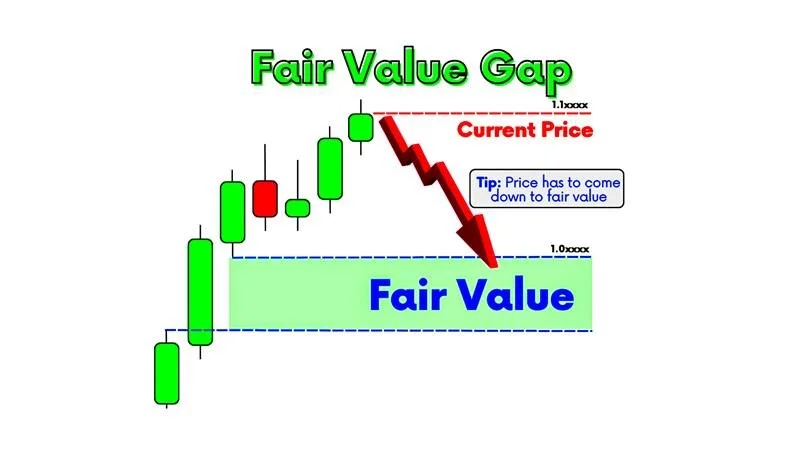
Anatomy of a Fair Value Gap (FVG)
A Fair Value Gap is defined by a specific three-candle pattern during a period of strong momentum, often referred to as displacement.
1. Identification: The Three-Candle Rule
The FVG is the empty space, or inefficiency, found between the first and third candles of an impulsive move:
Bullish FVG (Upward Move): The gap is the space where the low of the third candle is higher than the high of the first candle. The middle, or second, candle is the strong impulse candle.
Bearish FVG (Downward Move): The gap is the space where the high of the third candle is lower than the low of the first candle. Again, the middle candle is the strong impulsive move.
This gap signifies that the price moved too rapidly, leaving insufficient liquidity (unmatched buy and sell orders) in that zone. The market is seen as having delivered prices inefficiently.
2. The Market Logic: Seeking Balance
The core principle behind trading FVGs is that the market tends to revert to its "fair value." An FVG represents an anomaly where the price has deviated quickly from a balanced state.
The Magnet Effect: Price has a high probability (often cited as 70-80%) of returning to the FVG to "fill" or "mitigate" the imbalance. Institutions, who created the gap by entering aggressively, may use this retrace back into the gap to fill their remaining orders or scale into their positions more efficiently.


FVG Trading Strategies for Forex Trading
FVGs are used primarily as precise entry zones for high-reward-to-risk setups, often combined with broader technical analysis.
1. Trend Continuation Entry
The most common and reliable application of the FVG is trading in the direction of the prevailing trend:
Scenario: In an uptrend (or a bullish market structure break), a Bullish FVG is created by a strong upward impulse.
Strategy: Forex Traders wait patiently for the price to retrace back down into the FVG zone. Once the price touches the gap and shows a confirmation signal (e.g., a strong bullish candle or a lower timeframe shift in structure), they enter a long position.
Stop Loss: Placed strategically just below the lower boundary of the Bullish FVG.
Target: Set at the previous swing high or the next significant liquidity zone.
2. Confluence with Smart Money Concepts (SMC)
The power of the FVG multiplies when combined with other SMC tools, a concept central to the teachings of GME Academy/Global Markets Eruditio:
Order Blocks: When an FVG is found resting near an Order Block (a specific candle that initiated a strong institutional move), the signal strength is significantly enhanced. The Order Block provides the "cause" (institutional demand/supply), and the FVG provides the "precision" (the exact inefficiency to target for entry).
Market Structure: FVGs are most reliable when they form after a Break of Structure (BOS) or a Change of Character (CHOCH), as this confirms that a major directional move has been initiated by strong institutional force.
3. Risk Management and Precision
FVGs offer clear boundaries for disciplined risk management:
Risk-Reward Ratio (RRR): Due to the tight entry within the gap and the expectation of a quick move back to the trend, FVGs frequently offer attractive RRRs, often 1:2 or higher.
Timeframe Alignment: Traders, including Forex Trading for Beginners, are advised to identify the main trend and major FVG on a higher timeframe (H4 or Daily) and then use a lower timeframe (M5 or M15) to confirm the price reaction and execute a precise entry upon the retrace.
FVG vs. Imbalance: A Clarification
While the terms are often used interchangeably, some professional traders distinguish them:
Imbalance (IMB): Often refers to the entire price segment covered by the impulsive middle candle, where one side of the market is dominated.
Fair Value Gap (FVG): Is the specific, narrower untouched region of that impulsive candle between the wicks of the first and third candles.
In practice, for most Forex traders of currency pairs like EUR\USD or GBP\JPY, the FVG marks the high-probability entry zone within the larger area of imbalance.
The Fair Value Gap provides a tangible footprint of institutional activity on the price chart, allowing well-informed traders to stop chasing momentum and instead wait for a calculated, asymmetric entry at the price levels that the smart money is likely to revisit.
Are You Identifying the Hidden Footprints of Smart Money?
FVGs are not magic, but a logical consequence of order flow. Ignoring them means missing out on the most precise institutional entry points.
Master the art of reading pure price action and identifying these crucial imbalances.
Join the GME Academy community today and sign up for our FREE Forex Workshop to learn how to combine FVGs with market structure for high-probability setups, securing a comprehensive understanding of the forces that move the market.
