

The Arrival of the "True Dawn": BOJ’s Hajime Takata on Japan’s Monetary Pivot
In a comprehensive address to local leaders in Kyoto, Hajime Takata, Member of the Policy Board of the Bank of Japan (BOJ), signaled a historic shift in Japan’s economic narrative. Takata argued that the "frozen era" of deflation is finally thawing, paving the way for a "true dawn" where wage growth and inflation become the new permanent norm.
His speech on February 26, 2026, highlighted a global shift from "north wind" policies (pressure and tariffs) to "sun" policies (growth and deregulation), providing a tailwind for Japan to achieve its elusive price stability target.
1. Global Context: From "North Wind" to "Sun"
Takata noted that the global economic environment is entering a shifting phase. In 2025, the world faced a "north wind" characterized by U.S. reciprocal tariffs and trade friction. However, with the One Big Beautiful Bill Act (the U.S. tax reform of July 2025) and widespread deregulation, the environment is shifting to a "sun" policy that encourages investment.
Synchronized Easing: Much like during the 2020 pandemic, central banks globally cut rates in 2025 to manage risk.
The AI Boom: Takata emphasized that the global AI investment surge is providing a structural uplift to productivity and demand, mirroring the stimulus-driven recovery of six years ago.
Avoidance of Recession: Despite initial fears, the U.S. economy remained resilient, allowing the Federal Reserve to pause its easing cycle in January 2026, which in turn stabilized the Yen.
2. Japan’s "True Dawn": Why This Time is Different
Takata famously used the analogy of frozen food in a microwave to describe Japan’s economy. For decades, the "surface" (headline inflation) would thaw, but the "center" (underlying inflation/wages) remained frozen.
The shift to a "Labor Shortage Economy":
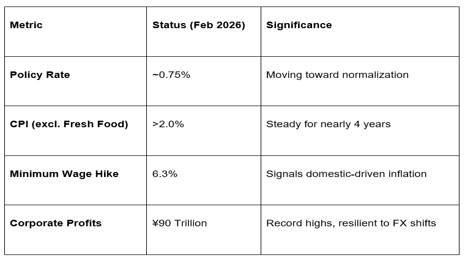
Wage Hike Norms: Japan is on the verge of its fourth consecutive year of significant wage increases. The 2026 spring negotiations are expected to match the high levels of 2025, with Keidanren now accepting base pay increases as the standard.
Minimum Wage Momentum: The national weighted average of the minimum wage has risen by 6.3%, symbolizing a fundamental change in the "deflationary norm" where prices and wages were expected to stay flat.
Corporate Resilience: Despite U.S. tariffs, Japanese firms have maintained high profits (reaching nearly ¥90 trillion in fiscal 2024). Years of restructuring have lowered their break-even points, making them "shock-proof."
3. The "Gear Shift" in Monetary Policy
Takata revealed that at the January 2026 Monetary Policy Meeting, he proposed raising the policy interest rate to 1.0%. While the proposal did not pass, his stance highlights a growing hawkishness within the Board.
The Neutral Interest Rate: Takata likened the neutral rate to a rainbow—visible from afar but vanishing when you get closer. He warned that if Japan does not raise rates gradually, it risks falling "behind the curve" as global economies recover.
Real Interest Rates: While Japan’s nominal rates are no longer the lowest in the world, its real interest rates (nominal rate minus inflation) remain deeply negative and are currently the lowest globally.
Exiting the "Frozen Era": Takata argues that since the price stability target of 2% has been effectively achieved for nearly four years, the Bank must assume a communication style that reflects this success.


GME Academy Analysis: "The End of the Carry Trade?"
At Global Markets Eruditio, we are focusing on Takata’s insistence that the "divergence of monetary policy" is no longer a primary constraint for the BOJ.
Trader's Takeaway for February 2026:
USD/JPY Dynamics: Takata’s belief that Fed rate cuts in 2025 were "risk management" rather than a recessionary spiral suggests that the Yen is unlikely to see a massive, forced appreciation. This gives the BOJ more room to hike without crashing the export sector.
JGB Yield Curve: As the BOJ "shifts gears," expect the 10-year JGB yield to face upward pressure. Takata’s 1.0% target for the policy rate suggests the terminal rate may be higher than current market pricing.
Stock Market Sentiment: Japanese stocks (Nikkei 225) recently hit historical highs. If Japan has truly entered a "true dawn" of domestic consumption and investment, the market may decouple from its historical reliance on a weak Yen.
Join our FREE Macro Workshop at Global Markets Eruditio!
Is Japan's 1.0% rate hike inevitable? We’ll analyze Takata’s "Sun Policy" Framework and show you how to trade the AUD/JPY and USD/JPY as the BOJ prepares for its next move
