

The Great Freeze: Canada Retail Sales Slip in December as "Year of the Car" Ends
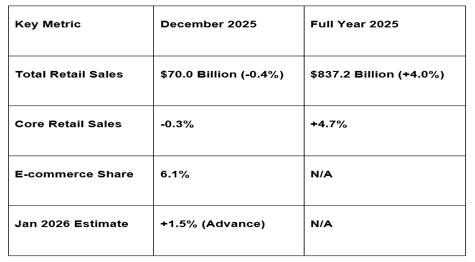
The Canadian consumer appears to be entering a defensive crouch as 2025 comes to a close. According to Statistics Canada data released on Monday, February 23, 2026, retail sales decreased 0.4 percent to $70.0 billion in December. This month-over-month decline was primarily driven by a sharp pullback in the automotive sector, suggesting that the post-pandemic "vehicle boom" may finally be exhausting itself.
Despite the December dip, the full-year picture remains resilient, with Canadian retailers clocking a total of $837.2 billion in sales for 2025—a 4.0 percent increase over the previous year.

1. The Auto Sector Reversal
For most of 2025, new car dealers were the primary engine of Canadian retail growth. However, December saw a significant shift in momentum.
Motor Vehicle Slump: Sales at motor vehicle and parts dealers fell 1.6 percent, led by new car dealers (-1.8%) and used car dealers (-1.8%). This marks the second consecutive month of declines for new car sales.
Core Retail Weakness: Excluding fuel and autos, "Core" retail sales fell 0.3 percent. The biggest drag came from building material and garden supplies (-4.0%), which erased two months of gains as the winter "chill" hit the construction and DIY sectors.
The Silver Lining: Gasoline stations and fuel vendors saw a 2.8 percent increase in sales value, though this was largely driven by a 4.5 percent jump in volume, indicating that Canadians were still on the move during the holiday season despite lower prices throughout the year.
2. Provincial Breakdown: Alberta Feels the Hit
The slowdown was not evenly distributed, with seven out of ten provinces reporting a contraction in December.
Alberta’s Heavy Blow: The province saw the largest dollar-term decrease, falling 2.1 percent. This was almost entirely attributed to the collapse in motor vehicle sales.
Ontario and Toronto: Ontario saw a marginal decline of 0.2 percent. However, the Toronto CMA remained a "growth island," with sales actually increasing 0.5 percent.
Quebec’s Resiliency: Quebec posted the largest provincial gain at +0.6%, though its primary hub, Montréal, saw sales dip 0.8%.
3. E-commerce and the 2026 "January Bounce"
While brick-and-mortar stores struggled, the digital economy continued its steady climb.
E-commerce Surge: Retail e-commerce sales increased 3.6 percent to $4.3 billion in December. Online shopping now accounts for 6.1 percent of total Canadian retail trade, up from 5.8 percent in November.
The "Advance" Hope: In a surprising twist, Statistics Canada’s advance indicator suggests that January 2026 sales may have rebounded by 1.5 percent. If this unofficial figure holds, it suggests that the December slump was a temporary "holiday hangover" rather than a prolonged recessionary trend.


GME Academy Analysis: "The CAD Carry Caution"
At Global Markets Eruditio, we are carefully watching the December data as a signal for the Bank of Canada’s (BoC) next move.
Trader's Takeaway for February 2026:
Loonie Volatility: The 0.4% decline in December is a "dovish" signal for the Canadian Dollar (CAD). If the January bounce (+1.5%) doesn't materialize in the final data, the BoC may be forced to pivot toward rate cuts faster than the Federal Reserve.
USD/CAD Levels: With the Trump 15% Tariff threat looming (as of yesterday’s news), the CAD is facing a "double-whammy" of weak internal growth and external trade pressure. We are watching the 1.3800–1.4000 range closely.
Sector Play: Retailers in Health and Personal Care (+6.7% in 2025) and Clothing (+9.6%) remain the most resilient plays in a high-interest-rate environment.
Join our FREE Macro Workshop at Global Markets Eruditio!
Is the January bounce a fake-out? We’ll analyze the BoC’s Reaction Function to the retail slump and show you how to trade the CAD during the "Tariff Crisis."
