

The Hawkish Pivot: Decoding RBA Hauser’s "Return to Target" Warning
In the unfolding economic narrative of 2026, the Reserve Bank of Australia (RBA) has shifted from a stance of cautious observation to one of active intervention. On February 11, 2026, Deputy Governor Andrew Hauser delivered a clear message to markets: the RBA will do "whatever is necessary" to wrestle inflation back into the 2–3% target band.
At the GME Academy, we view Hauser’s remarks as the final confirmation that the "Easing Era" of 2025 is officially over. For traders and homeowners alike, the landscape has changed.

1. The "Uncomfortably High" Reality
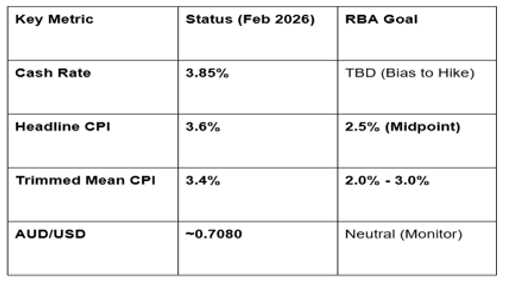
Hauser’s primary concern is the persistence of underlying inflation, which accelerated to 3.4% in the fourth quarter of 2025—far exceeding the RBA’s internal forecasts.
The Problem: While some temporary price spikes are expected to "unwind" (such as holiday travel and fuel), service inflation remains sticky.
Supply vs. Demand: Hauser noted that while the RBA can control demand via interest rates, supply constraints persist in sectors like housing and construction, making inflation harder to kill.
The "Speed Limit": As we discussed at Global Markets Eruditio, Australia is currently hitting its "economic speed limit," where even modest growth triggers immediate price pressures because the economy is running at near-full capacity.
2. The Rising AUD: A "Double-Edged" Sword
One of the more technical aspects of Hauser's speech was his commentary on the Australian Dollar (AUD). As of February 2026, the Aussie has hit fresh highs, trading near 0.7100 against the US Dollar.
Tightening Financial Conditions: A stronger currency acts like a "shadow rate hike." It makes imports cheaper (helping lower inflation) and exports more expensive (slowing the economy).
Hauser's View: He stated that the rising AUD has already helped "tighten financial conditions," which might do some of the RBA's heavy lifting.
The Trader's Trap: However, if the AUD rises too fast, it could hurt Australia's mining and education exports, potentially forcing the RBA to balance its hawkishness with the need to protect growth.
3. Monetary Policy: Is 4.10% the Next Stop?
Following the RBA’s 0.25% hike to 3.85% on February 3, markets are now pricing in another increase by mid-2026.
May 2026 Forecast: Many economists, including those at CBA, now predict a follow-up hike in May, bringing the cash rate to 4.10%.
Restrictive for Longer: Hauser emphasized that interest rates may not yet be "restrictive enough," given that credit growth remains strong. The RBA is prepared to maintain high rates until mid-2028, when they finally expect inflation to hit the midpoint of its target.


The GME Academy Analysis: "Don't Fight the Central Bank"
At Global Markets Eruditio, our golden rule is: Never fight the Fed, and never fight the RBA when they are in "inflation-slaying" mode.
Trader's Takeaway for 2026:
AUD/USD Long Bias: With the RBA signaling more hikes while the US Fed considers cuts, the "Interest Rate Differential" favors a stronger Australian Dollar. Look for "Buy the Dip" opportunities on AUD/USD toward the 0.7200 level.
The "Wait for May" Rule: Do not expect a rate cut anytime soon. If you are a mortgage holder or a swing trader, plan for a "Higher for Longer" environment throughout the rest of 2026.
Watch the Data: The RBA is now "data-dependent." The next March Quarter CPI print (due in late April) will be the "smoking gun" that determines if the May hike happens or if the RBA pauses.
Join our FREE Forex Workshop at Global Markets Eruditio!
Want to learn how to trade the "Hawkish AUD"? We’ll show you how to use Interest Rate Parity to project currency moves and provide you with our "RBA Policy Tracker" to stay ahead of the next Deputy Governor speech.
