

The "Stuck" Generation: January Home Sales Plunge as NAR Declares a New Crisis
The U.S. housing market has hit a significant roadblock to start the year. In a report released on February 12, 2026, the National Association of Realtors (NAR) revealed that existing-home sales in January tumbled by 8.4% from December. The decline was far steeper than the 4.6% drop economists had predicted, marking the biggest monthly slide in nearly four years.
At the GME Academy, we are calling this the "Affordability Illusion." While interest rates have eased from their 2024 peaks, the combination of record-high prices and stagnant inventory has left many Americans "stuck" in a market that simply isn't moving.
1. The Paradox of 2026: Cheaper Credit, Higher Prices
On paper, the market should be recovering. Mortgage rates have dipped to 6.1%, and wage growth is finally outpacing inflation. Yet, the data tells a different story:
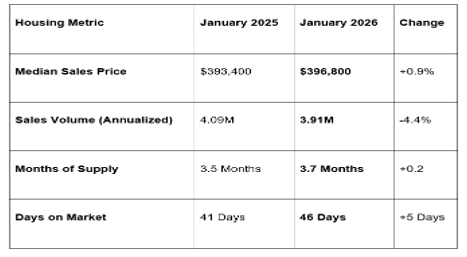
Record Prices: The median home price in January hit $396,800—the highest ever recorded for the month of January.
Volume Crunch: Sales fell to a seasonally adjusted annual rate of 3.91 million units, a levels not seen since the depth of the 2023 slowdown.
The Regional Hit: The South and West saw the most significant pullbacks, with sales in the West dropping 10.3% month-over-month.
2. "Americans Are Stuck": The New Housing Crisis
NAR Chief Economist Lawrence Yun didn't mince words during the release, characterizing the current environment as a "new housing crisis."
"Movement is not happening," Yun noted. "The buyers are struggling, and renters are not participating in housing wealth."
This "crisis" is driven by a unique gridlock:
The Golden Handcuff Effect: Existing homeowners with 3% or 4% mortgage rates are refusing to sell, even as inventory rose slightly (up 3.4% year-over-year).
The Missing Middle: Sales of homes priced below $250,000 have collapsed, while the luxury market ($1 million+) remains the only segment showing any growth.
Balanced Market Gap: We currently have a 3.7-month supply of homes. A "balanced" market requires a 6-month supply. Until that gap is bridged, sellers hold all the leverage.
3. Winners and Losers: Equity vs. Entry
The 2026 market is sharply divided between those already in the "club" and those trying to break in.
The Equity Boom: Since January 2020, the typical homeowner has accumulated $130,500 in housing wealth purely through appreciation.
The First-Time struggle: First-time buyers made up 31% of sales in January. While up from last year, many are only able to compete by using "Bank of Mom and Dad" or tapping into retirement assets at age 40—the new median age for a first-time buyer.
Time on Market: Homes are taking longer to sell—46 days compared to 41 last year—suggesting that buyers, while desperate, are becoming more "picky" about what they can afford.


The GME Academy Analysis: "Trade the Inventory Lag"
At Global Markets Eruditio, we analyze how the housing freeze impacts the broader economy.
Trader's Takeaway for 2026:
Consumer Spending Watch: When "Americans are stuck," they spend less on furniture, appliances, and home renovations. We are watching Retail Sales data closely for a corresponding dip.
The "Lumber Long": With existing homes off the table, the burden falls on New Home Construction. We expect new home sales to outperform existing sales in Q2 2026. Keep an eye on homebuilder ETFs like ITB and XHB.
Real Estate Sentiment: The "Disappointing Start" to 2026 puts pressure on the Federal Reserve to consider more aggressive cuts later this year to jumpstart the "housing heart" of the economy.
Join our FREE Forex and Macro Workshop at Global Markets Eruditio!
Is the housing crisis a sign of an impending recession or just a supply-side hiccup? We’ll show you how to read Housing Starts and Building Permits to predict the next big move in the USD.
