

Target Breached: Japan’s Inflation Dips Below 2% for First Time Since 2022
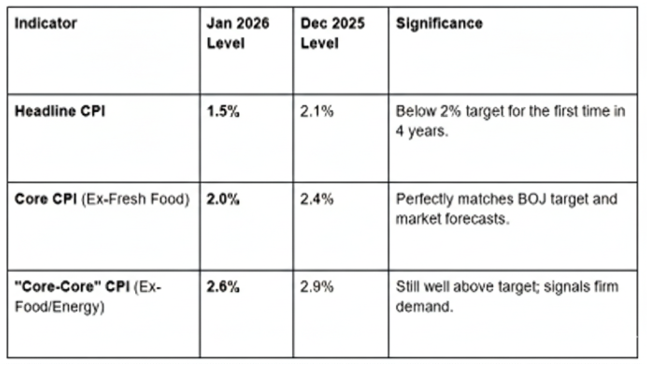
In a landmark shift for the world’s fourth-largest economy, Japan’s headline inflation rate plummeted to 1.5% in January 2026. This reading, released on Friday, February 20, marks the first time since March 2022 that consumer price growth has fallen below the Bank of Japan’s (BOJ) 2% target, ending a persistent 45-month run of elevated prices.
The data confirms a cooling trend driven by stabilizing food costs and aggressive government interventions, even as underlying price pressures suggest the BOJ’s "normalization" path remains intact.
1. The Drivers: From "Rice Shock" to Tax Relief
The drop from December’s 2.1% to 1.5% was more than a statistical fluke; it was the result of a deliberate fiscal-monetary "pincer move."
Food Costs Easing: Fresh food prices, which haunted Japanese households throughout 2025, have finally begun to fade. Rice inflation, which peaked at historic levels last year, slowed for an eighth straight month to 27.9%.
The "Takaichi Effect": Prime Minister Sanae Takaichi, fresh off a landslide election victory on February 8, has moved swiftly on her pledge to suspend the 8% food consumption tax for two years. Analysts estimate this move alone could eventually pull CPI down by nearly 2.0 percentage points.
Energy Subsidies: Sharper drops in petroleum products and the lingering effects of the December fuel tax scrap also contributed to the headline retreat.
2. Core vs. Headline: A Tale of Two Gauges
While the 1.5% headline grabber suggests a return to the "deflationary mindset," the BOJ’s preferred gauges tell a story of "sticky" underlying inflation.
3. Monetary Policy: Why a Rate Hike is Still on the Table
Counter-intuitively, the drop below 2% might not stop Governor Kazuo Ueda from raising rates. Norihiro Yamaguchi, lead Japan economist at Oxford Economics, notes that the BOJ is looking past "volatile" food and energy distortions.
June Hike Forecast: Market consensus is shifting toward a 25-basis-point hike in June 2026, bringing the policy rate to 1%.
Spring Wage Tussle: The BOJ is waiting for the results of the Shunto spring wage negotiations. If wages rise by the anticipated 5% again this year, it will provide the "virtuous cycle" of wage-driven inflation the bank has sought for decades.
Avoiding a Recession: The inflation data follows a slim 0.1% GDP growth in Q4 2025. By narrowly avoiding a technical recession, Japan has given the BOJ the "green light" to continue raising rates from near-zero levels.


GME Academy Analysis: "The JPY Divergence"
At Global Markets Eruditio, we are monitoring the widening gap between Japan’s cooling inflation and its hawkish central bank.
Trader's Takeaway for February 2026:
USD/JPY Levels: Despite lower inflation, the Yen remains under pressure due to the "Sanaenomics" fiscal expansion. If the BOJ doesn't hike in June, we could see the pair test the 155.00 handle.
Nikkei 225: Lower inflation is generally a "goldilocks" scenario for Japanese equities, provided it is accompanied by the Prime Minister's promised tax cuts.
Fixed Income: JGB yields are trending higher as markets price in the "Neutral Rate" of 1.5% by 2027.
Join our FREE Macro Workshop at Global Markets Eruditio!
Is Japan entering a "New Era" of low inflation and high rates? We’ll break down the Takaichi Tax Plan and show you how to trade the June BOJ Decision.
