

The Shutdown Slump: U.S. GDP Growth Slows to 1.4% in Final Quarter of 2025
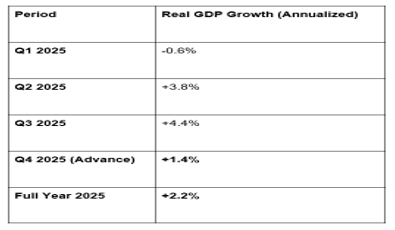
The U.S. economy hit a significant speed bump in late 2025, with growth cooling to a 1.4% annual rate in the fourth quarter. The data, released by the Bureau of Economic Analysis (BEA) on Friday, February 20, 2026, reveals the heavy toll taken by the record-breaking 43-day government shutdown that paralyzed Washington through October and November.
The 1.4% figure represents a sharp deceleration from the robust 4.4% growth recorded in the third quarter, signaling that the "extraordinary momentum" of 2025 was effectively derailed by political gridlock and trade disruptions.

1. The "Shutdown Squeeze"
The advance report—originally due in late January—was delayed by nearly a month as federal agencies worked to clear the backlog of data caused by the lapse in appropriations.
The 1.0% Drag: The BEA estimated that the reduction in labor services supplied by federal employees alone subtracted roughly 1.0 percentage point from real GDP growth.
Non-Defense and Defense Hits: Both sectors saw a significant decline in consumption expenditures and employee compensation, though federal workers eventually received back pay.
Trump’s Reaction: Before the data was released, President Trump took to social media to blame the "Democrat Shutdown" for costing the U.S. "at least two points in GDP," reinforcing his stance against further fiscal impasses.
2. Under the Hood: AI and Investment vs. Goods Pullback
While the headline number was weak, the internal mechanics of the report showed a "K-shaped" divergence in the American economy.
The AI Cushion: Business investment remained a bright spot, particularly in intellectual property and information processing equipment (notably computers and peripherals). AI-related R&D and data center expansion were credited with blunting the hit from tariffs.
Consumer Spending Slowdown: Consumer spending grew at a 2.4% rate, down from 3.5% in Q3. While health care and international travel (services) remained strong, goods purchases actually edged down by -0.1%, as middle- and lower-income households felt the pinch of higher prices.
The Trade Gap: Exports fell by 0.9%, reflecting disruptions in global commercial relations, while imports also declined.
3. Full-Year 2025: A Year of Volatility
Despite the weak fourth quarter, the U.S. economy managed to expand by 2.2% for the full year of 2025.
Inflation remained "sticky" through the end of the year, with the PCE Price Index increasing 2.9% in Q4, slightly higher than the 2.8% seen in the third quarter.


GME Academy Analysis: "The Base Effect Bounce"
At Global Markets Eruditio, we view this "stale" GDP print as a backward-looking distortion rather than a sign of imminent recession.
Trader's Takeaway for February 2026:
Q1 2026 Rebound: Much of the output lost during the shutdown is expected to be recovered in early 2026 as federal services normalize. We are projecting a "relief bounce" that could see Q1 2026 GDP test the 2.5%–3.0% range.
Fed Policy Neutral: Because the 1.4% figure was so clearly impacted by the "one-off" shutdown, it is unlikely to push the Fed toward an emergency rate cut. The focus remains on Miran’s "less accommodative" path and the March inflation data.
Fixed Income: 10-year Treasury yields held steady at 4.08% following the release, as markets had already largely "priced in" a weak result due to the well-documented shutdown.
Join our FREE Macro Workshop at Global Markets Eruditio!
Are we entering a "Goldilocks" 2026 or a stagflation trap? We’ll break down the Q4 Final Revisions and show you how to trade the "Post-Shutdown Recovery."
