

Mapping the Nomadic Workforce: Two Decades of Interjurisdictional Employment in Canada (2002–2022)
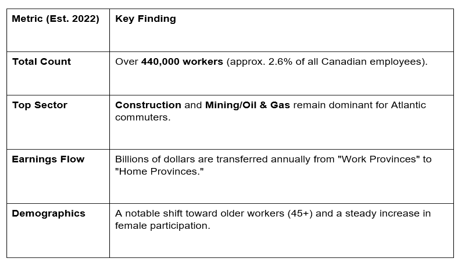
In a recently updated report from Statistics Canada, new light has been shed on one of the most flexible segments of the Canadian labor market: interjurisdictional employees (IJEs). These are individuals who live in one province or territory but travel to another for their primary job.
Covering the period from 2002 to 2022, the data reveals how this "nomadic" workforce serves as a vital economic bridge—channeling labor to booming regions while sending significant income back to home communities. At the GME Academy, we view these labor flows as critical indicators of regional economic health and the overall resilience of the Canadian Dollar (CAD).

1. Defining the Interjurisdictional Employee
An interjurisdictional employee is formally identified as a worker who:
Maintains their permanent residence in one province or territory (reported on their T1 tax return).
Receives T4 earnings from an employer located in a different jurisdiction.
This category excludes "migrants" who have permanently moved. Instead, it captures the "commuter" or "rotational" workforce—think of an oil and gas specialist living in Newfoundland and Labrador but working in Alberta, or a tech consultant residing in Quebec but employed in Ontario.
2. Two Decades of Trends: From Oil Booms to Post-Pandemic Shifts
The 20-year span from 2002 to 2022 shows that interjurisdictional employment is highly sensitive to commodity prices and national economic cycles.
The Resource Peak (2002–2014): Driven by the global oil boom, the number of IJEs grew significantly, peaking as workers from across the country flocked to the Alberta oil sands.
The 2015 Slump: Following the oil price crash, there was a notable decline in interjurisdictional work, particularly in the mining and construction sectors.
The Pandemic and Beyond (2020–2022): While remote work allowed some to stay home, the 2022 data shows a "sharp rebound" in sectors like public administration, finance, and construction as physical projects and office-based hubs resumed operations.
3. Regional Impact: Winners and Senders
Interjurisdictional employment creates a unique "circular economy" within Canada:
Source Jurisdictions (Atlantic Canada & Saskatchewan): For provinces like Prince Edward Island and Newfoundland and Labrador, IJEs are a massive source of outside income. These workers pay income taxes in their home province, supporting local schools, hospitals, and infrastructure despite earning their wages elsewhere.
Host Jurisdictions (Ontario, British Columbia, Alberta): These provinces benefit from a "ready-to-work" labor force that fills critical gaps in specialized industries without placing immediate long-term pressure on local housing and social services.
4. The 2026 Perspective: New Methodology for Better Accuracy
The latest release (February 9, 2026) uses a revised methodology to ensure consistency. Previously, "incoming" and "outgoing" counts didn't always match perfectly due to workers holding multiple jobs. The new system focuses on the "main job" (the one with the highest earnings), providing a cleaner, more reliable look at where the money is truly being made and spent.


The GME Academy Analysis: "Labor Mobility and the Loonie"
At Global Markets Eruditio, we analyze these reports because labor mobility is a safety valve for the economy. When workers can move freely to where the jobs are, it prevents "localized recessions" and helps stabilize the Canadian Dollar (CAD).
What Traders Should Watch:
Regional Inflation: High levels of incoming IJEs can signal labor shortages, which may lead to wage-push inflation in specific provinces.
Housing Trends: Provinces with high "outgoing" IJEs often see resilient real estate markets, as workers bring high salaries back to lower-cost-of-living regions.
Join our FREE Forex Workshop at Global Markets Eruditio!
Want to learn how to trade the USD/CAD based on Canadian labor and energy data? We’ll show you how to read Statistics Canada reports like a pro to identify the underlying strengths of the Canadian economy.
