

New Zealand Labour Market: Unemployment Hits Decade High of 5.4% Amid Record Participation
New Zealand's labour market continues to signal a complex "cooling" period. According to the latest data from Stats NZ for the December 2025 quarter, the unemployment rate has ticked up to 5.4%—the highest level seen since 2015. However, the data reveals a "better than it looks" narrative: the rise in jobseekers is being driven by a surge of people entering the workforce, rather than a total lack of job creation.
At the GME Academy, we view these numbers as a classic "Late Cycle" adjustment. For Forex traders, the combination of higher unemployment and cooling wage growth is a "Dovish" signal for the NZD, providing the Reserve Bank of New Zealand (RBNZ) with the evidence needed to maintain or potentially ease its current interest rate stance.

1. The Headline Shift: More Jobs, More Seekers
The unemployment rate rose from 5.3% to 5.4%, which translates to roughly 165,000 Kiwis currently out of work. Interestingly, the economy actually added 15,000 jobs during the quarter—the strongest growth in two years—but it wasn't enough to absorb the 19,000 new people who joined the labour force.
Labour Force Participation: Reached 70.5%, up from 70.3%.
Employment Rate: Edged up slightly to 66.7%, signaling that despite the headlines, hiring remains surprisingly resilient.
Underutilisation: Remained steady at 13.0% (409,000 people), representing the total untapped capacity in the market.
2. Demographic Breakdown: Who is Most Affected?
The burden of the cooling market is not shared equally. Men and women saw similar slight increases in unemployment, but ethnic disparities remain stark.
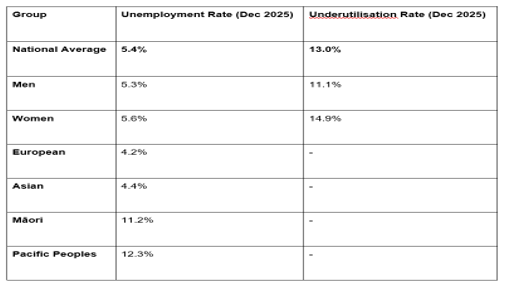
Note: While the Pacific and Māori rates remain high, Stats NZ noted that changes within the last year were not statistically significant, suggesting a stabilization at these elevated levels.
3. Wages vs. Inflation: The Real Income Gap
For the average worker, the most concerning trend is the "Real Wage Gap." While your paycheck might be getting bigger in nominal terms, its purchasing power is still being eroded by the cost of living.
Wage Growth (LCI): Annual salary and wage rates increased by 2.0%.
Inflation (CPI): Annual inflation hit 3.1% in December 2025.
The Reality: With inflation outpacing wage growth, the "average" Kiwi worker effectively saw a 1.1% decrease in real wages over the year.
4. Regional Trends: The North-South Divide
Economic activity is currently favoring the South Island, while major North Island hubs are feeling the pinch of public sector cuts and a cooling services sector.
Auckland: Hit an unemployment rate of 6.4%.
Wellington: Rose to 5.8%.
Canterbury: Remained robust at 3.7%.
Otago: The nation's strongest region with just 2.3% unemployment.


The GME Academy Analysis: "The RBNZ's Green Light"
At Global Markets Eruditio, we anticipate that these figures will weigh on the New Zealand Dollar (NZD). The RBNZ’s target is to keep inflation between 1–3%. With inflation at 3.1% and the labour market showing clear signs of "slack" (higher unemployment and slowing wages), the central bank is unlikely to hike rates further.
Are You Trading the NZD Volatility?
The December quarter shows a market that is softening but not crashing. The high participation rate suggests Kiwis are still optimistic about finding work, but the wage-inflation gap is the key metric to watch for 2026.
Join our FREE Forex Workshop
Learn how to trade "Employment Data Surprises." We’ll show you how to read the LCI vs. CPI gap to predict the RBNZ’s next move and how to protect your Kiwi Dollar assets from regional economic shifts.
