

The "No-Hire, No-Fire" Economy: US Jobless Claims Hit Tame Levels Amid Market Fog
In a week defined by economic "stabilization" and a cautious Federal Reserve, the latest U.S. labor data paints a picture of a remarkably resilient—if stagnant—workforce. For the week ending January 24, 2026, initial jobless claims inched down by 1,000 to a seasonally adjusted 209,000.
At the GME Academy, we see this as the hallmark of a "No-Hire, No-Fire" cycle. While hiring has cooled significantly, companies are clinging to their existing staff, fearful of the labor shortages that followed the 2024-2025 recovery. For Forex Trading, this data provides a "steady-as-she-goes" backdrop for the US Dollar (USD), even as global trade uncertainty looms.

1. Initial Claims: Subdued Layoffs Despite High-Profile Headlines
Despite headlines of job cuts at giants like Amazon and UPS this week, the aggregate data shows that broad-based layoffs are not materializing.
The Numbers: Initial claims fell to 209,000, slightly above the 206,000 consensus but still near historically healthy levels.
The Revision: The previous week was notably revised upward by 10,000 to 210,000, suggesting that the "gradual softening" Chair Powell mentioned on Wednesday is indeed underway.
4-Week Moving Average: Now stands at 206,250, an increase of 2,250. This "smoothing" metric confirms a very slight upward trend in new filings over the past month.
2. Continuing Claims: A Post-Shutdown Low
The real surprise in the report was the drop in insured unemployment (continuing claims), which measures people already receiving benefits.
The Stat: Continuing claims fell by 38,000 to 1.827 million for the week ending January 17.
The Record: This is the lowest level since September 21, 2024.
The Caveat: Economists warn that this "improvement" might be misleading. Many workers have likely exhausted their 26 weeks of eligibility, causing them to drop off the rolls without actually finding new employment—a sign of the "tepid hiring" currently plaguing the market.
3. Regional Divergence: New York vs. California
The unadjusted data reveal a sharp contrast in how different states are weathering the early 2026 economic environment:
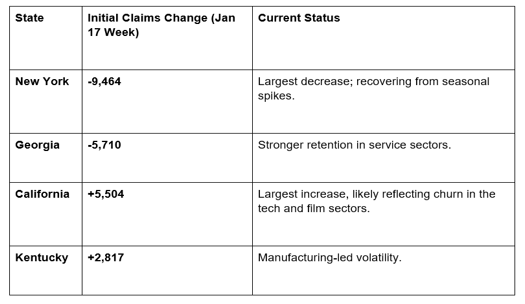
Market Note: Rhode Island (2.9%) and New Jersey (2.8%) currently hold the highest insured unemployment rates in the nation, reflecting sticky labor challenges in the Northeast.
4. Forex & Fed Impact: The "Stable" Label
This data supports Federal Reserve Chair Jerome Powell's Wednesday statement that the labor market is "stabilizing after a period of gradual softening."
For USD/PHP: The lack of a "spike" in jobless claims keeps the Fed from rushing into emergency rate cuts. This maintains the "yield advantage" for the Dollar, keeping the Peso under pressure near the 58.00 level.
For the 10-Year Treasury: Yields rose slightly on the news, as the low level of layoffs suggests the economy is not yet in need of aggressive stimulus.
The "One-Off" Factor: As long as layoffs remain low, the Fed can focus entirely on "filtering" tariff inflation, as we discussed in our previous coverage.


The GME Academy Analysis: "Attrition Over Action"
At Global Markets Eruditio, we believe the labor market is in a "holding pattern." Companies are reducing headcounts through attrition (not replacing people who leave) rather than mass layoffs. While this keeps the "Initial Claims" number low, it makes finding a new job significantly harder for the average person.
Are You Trading the NFP Preview?
Next Friday's January Jobs Report is the big one. With consensus at a humble 50,000 job gains, today's claims data suggests we are on track for a "ho-hum" report that could keep the Fed on the sidelines for months.
Join our FREE Forex Workshop
Learn how to interpret "Lagging" vs. "Leading" indicators. We’ll show you why continuing claims can be a "trap" for traders and how to spot the real signs of a labor market breakdown before the USD reacts.
