

The Inflation Pinch: U.S. Spending Outpaces Income as Savings Rate Dips
The American consumer faced a challenging balancing act in the final month of 2025. According to the Bureau of Economic Analysis (BEA) report released on Monday, February 23, 2026, personal spending grew faster than income in December, while "sticky" inflation continued to erode the purchasing power of households.
The report, which was delayed nearly a month due to the October–November government shutdown, paints a picture of a resilient but increasingly strained consumer base navigating a high-cost environment.

1. Spending vs. Income: The Service Sector Surge
Personal income rose by $86.2 billion (0.3%) in December, driven primarily by compensation and government transfer receipts. However, consumers didn't hold back, pushing spending even higher.
Consumption Growth: Personal Consumption Expenditures (PCE) increased by $91.0 billion (0.4%).
The Goods vs. Services Divide: The growth was entirely lopsided. Spending on services surged by $98.5 billion, while spending on goods actually contracted by $7.5 billion. This suggests that while Americans are still paying for essentials and experiences (healthcare, travel, utilities), they are pulling back on physical products like electronics and furniture.
Real Growth Stalls: When adjusted for inflation, "Real PCE" increased by a meager 0.1%, indicating that most of the increased spending was simply to cover higher prices rather than buying more "stuff."
2. Inflation Watch: The Fed’s Favorite Gauge Heats Up
The PCE Price Index—the Federal Reserve’s preferred metric for measuring inflation—showed that price pressures remain uncomfortably high as we enter 2026.
Monthly Heat: The PCE price index rose 0.4% in December alone. Even when stripping out volatile food and energy costs, "Core PCE" also rose 0.4%.
The Annual Picture: Compared to December 2024, the PCE price index is up 2.9%, while the Core PCE index sits at 3.0%.
The Fed’s Target: With the 3.0% core reading remaining well above the Fed's 2% target, the hope for an early 2026 rate cut appears to be fading. This data supports Governor Miran’s recent "less accommodative" stance.
3. Savings Rate: The Safety Net Thins
As spending outpaced disposable income, the personal saving rate—saving as a percentage of disposable income—fell to 3.6%.
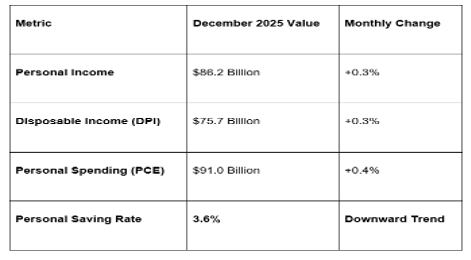
Total personal savings stood at $830.8 billion. While substantial, the declining rate suggests that households are dipping further into their reserves to maintain their lifestyle in the face of 3% inflation.

GME Academy Analysis: "The Consumer at the Crossroads"
At Global Markets Eruditio, we are tracking the "Savings-Inflation Divergence" as a major risk for the first half of 2026.
Trader's Takeaway for February 2026:
USD Strength: The 0.4% monthly inflation print is "hawkish." It reinforces the narrative that the Fed cannot afford to cut rates yet. We expect the US Dollar to remain dominant as yields stay elevated.
Service Sector Resilience: Despite high prices, the massive $98.5 billion jump in service spending is a boon for the Service-heavy S&P 500 sectors. We remain Overweight Healthcare and Travel.
Goods Warning: The decrease in goods spending (-$7.5B) is a red flag for retailers and manufacturers already dealing with the Trump 15% Tariff hike announced this weekend.
Join our FREE Macro Workshop at Global Markets Eruditio!
Is the U.S. consumer finally hitting a wall? We’ll break down the Post-Shutdown Spending Spree vs. The Savings Drop and show you how to trade the USD during this inflation "reheat."
