

The Compound Edge: A Framework for Continuous Improvement
In the trading environment of 2026, "standing still" is synonymous with moving backward. With the rapid integration of AI-driven analytics and the compression of market cycles, a trader’s most valuable asset isn’t their strategy—it’s their Framework for Continuous Improvement (CI).
At the GME Academy, we teach that peak performance is not a destination but a deliberate, repeating cycle. To survive the 2026 markets, you must move beyond occasional reviews and implement a structured PDCA (Plan-Do-Check-Act) system tailored for the digital age.
1. The PDCA Cycle for Modern Trading
The Plan-Do-Check-Act cycle, originally popularized by Dr. W. Edwards Deming, remains the gold standard for operational excellence. In 2026, we’ve adapted this loop specifically for the high-frequency world of Forex and Equities.
Phase 1: Plan (The Strategy Architect)
Continuous improvement starts before the first trade is placed.
Define the Edge: In 2026, this often involves defining your "AI-Human Hybrid" approach. What part of your analysis is automated, and what is discretionary?
Set Quantitative Benchmarks: Move beyond "I want to be profitable." Set specific targets: "Achieve a 1.5 Profit Factor over the next 50 trades with a maximum 3% drawdown."
Phase 2: Do (The Disciplined Execution)
Execution is the "laboratory" where your plan is tested.
Standardized Work: Follow your rules with zero deviation. If you change your strategy mid-trade, you destroy the data needed for improvement.
Small-Scale Testing: Use "Micro-Lots" when testing a new 2026 variable—such as a new AI sentiment indicator—before committing full capital.
Phase 3: Check (The Data-Driven Audit)
This is where 90% of traders fail. You must ruthlessly analyze the results of your execution.
Performance Metrics: Use automated journals (like those built into Global Markets Eruditio’s student portal) to track win rates, expectancy, and "MFE/MAE" (Maximum Favorable/Adverse Excursion).
Identify Root Causes: If you are losing, is it because the strategy is broken (Phase 1) or because your execution was sloppy (Phase 2)?
Phase 4: Act (The Strategic Pivot)
Based on your "Check" phase, you must now adjust the system.
Standardize Success: If a specific time-of-day filter improved your win rate by 5%, make it a permanent rule.
Discard Decay: If a strategy is underperforming its 2026 backtest, "bench" it until market conditions stabilize.
2. The "Lock-In" System: 2026 Accountability
In the 2026 Lock-In Trading System, we’ve added a layer of "Forced Discipline" to the CI framework.
The Two-Trade Limit: Professional CI requires a clean data set. By limiting yourself to two high-quality trades per day, you prevent "overtrading noise" from polluting your performance data.
The 40% Benchmark: We focus on a 40% win rate with a 1:4 Risk-to-Reward ratio. This allows for frequent "learning losses" while maintaining an upward equity curve.
3. Leveraging AI as a "Feedback Multiplier"
In 2026, you are no longer alone in your improvement journey.
Automated Scanners: Use AI to scan hundreds of charts to see if your "Plan" is still appearing in the market.
Sentiment Analysis: Integrate AI tools that track global news in real-time. If your CI audit shows you lose trades during "Geopolitical Spikes," use AI-driven alerts to stay sidelined during those windows.
Simulated Backtesting: AI can run 10,000 versions of your strategy in minutes, helping you identify "weak links" in your logic before you lose real money.
4. The 2026 Monthly Payout Rule
The ultimate goal of continuous improvement is Professionalism.
Treat Trading as a Business: In our framework, once your account reaches a specific profit target for the month (e.g., $600–$840 on a standard account), you must stop trading and request a payout.
The Reset: This enforces a "Monthly Cycle" where you withdraw profits, reset your discipline, and start the PDCA loop fresh for the next month.
 https://images.squarespace-cdn.com/content/619b666b5842697e2af69258/a9d57b27-4fad-4532-874a-89133d6a85bc/P477.02.jpg?content-type=image%2Fjpeg


The GME Academy Analysis: "Excellence is a Habit"
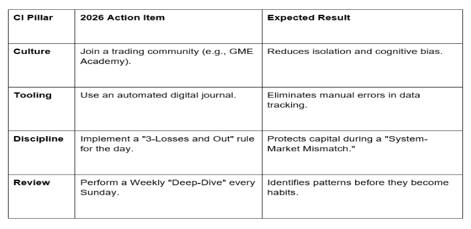
At Global Markets Eruditio, we believe that your trading results are a direct reflection of your review process.
Trader's Takeaway for 2026:
Don't Be a "Strategy Hopper": Improvement comes from refining one system, not trying ten. Stay with one setup for at least 30 trades before making any changes.
Focus on the "Fat Tails": Most of your losses likely come from 20% of your mistakes. Find those "Fat Tail" errors in your journal and eliminate them first.
USD/PHP Context: For our local students, the Philippine market is currently navigating shifting trade policies. Your CI framework must include a "Macro Check"—ensure your system accounts for the BSP (Bangko Sentral ng Pilipinas) interest rate updates, which are currently highly sensitive to US Fed moves.
Join our FREE Forex Workshop at Global Markets Eruditio!
Ready to implement the PDCA Cycle in your own trading? We’ll provide you with our "2026 Continuous Improvement Roadmap" and show you how to use AI-driven metrics to find the "hidden leak" in your current strategy.
