

The Circulatory System of Wealth: Flow of Funds in Capital, Trade, and Banking
In the global economy of 2026, money never truly sits still. It behaves like a circulatory system, moving through distinct yet interconnected "vessels" of capital, trade, and banking. Understanding this Flow of Funds (FOF) is essential for grasping how a tech boom in Silicon Valley can lower borrowing costs in Manila or how a trade dispute in Europe can trigger a banking crisis in South America.
At the GME Academy, we break down this "macroeconomic accounting" to help traders and students visualize the invisible forces driving the markets.
1. The Three Pillars of the Flow
To understand the global flow, you must distinguish between three primary types of movement:
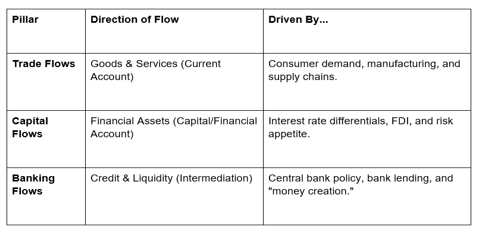 https://images.squarespace-cdn.com/content/619b666b5842697e2af69258/a9d57b27-4fad-4532-874a-89133d6a85bc/P477.02.jpg?content-type=image%2Fjpeg
The Golden Rule of FOF: The sum of all flows across the globe must equal zero. If one country (like the US) runs a trade deficit (importing more than it exports), it must necessarily run a capital account surplus (borrowing from the rest of the world to pay for those imports).
2. Trade as the Engine
Trade flows are the most "visible" part of the system. When a Filipino company exports electronics to a buyer in Japan, money flows from Japan to the Philippines.
The 2026 Shift: According to the IMF’s January 2026 update, global trade has remained resilient at 3.3% growth, largely fueled by "digitally deliverable services" and the AI-linked hardware boom.
The Balancing Act: Trade flows create the initial demand for currencies. For the Peso (PHP), strong electronics exports provide a natural "sink" for US Dollars, supporting the local currency's value.
3. Capital as the Fuel
Capital flows are often faster and more volatile than trade. These flows represent investors seeking the highest "risk-adjusted" return.
Foreign Direct Investment (FDI): Long-term flows where companies build factories or buy businesses (e.g., a Chinese EV company building a plant in Mexico). These are the most stable "pull" factors.
Portfolio Flows ("Hot Money"): Short-term flows into stocks and bonds. In 2026, as the US Dollar has shown signs of softening, capital has begun flowing back into Emerging Markets (EMEs) like the Philippines and India, where valuations are seen as more attractive.
Institutional Discipline: As the BIS noted in recent working papers, global capital flows now act as a "golden straitjacket," forcing governments to maintain fiscal discipline to avoid a "sudden stop" or capital flight.
4. Banking as the Plumbing
If trade is the engine and capital is the fuel, the Banking System is the plumbing that connects them.
Intermediation: Banks take "excess" savings from one part of the world (sources) and lend them to areas with "excess" demand for investment (uses).
Credit Creation: When a bank in London provides a letter of credit to a trader in Singapore, it is effectively "creating" the liquidity that allows trade to happen.
The 2026 Trend: We are seeing a shift from traditional banks to Non-Bank Financial Intermediaries (NBFIs) and "Alternative Investments." As liquidity becomes a strategic pillar, tools like NAV financing and Tokenization are becoming mainstream, allowing for even faster cross-border movements of wealth.
5. The "Trilemma" and Policy Risks
Central banks, including the BSP and the ECB, must manage these flows while balancing three conflicting goals (The Impossible Trilemma):
Fixed Exchange Rates
Free Capital Movement
Independent Monetary Policy
In 2026, most nations have chosen to prioritize Monetary Independence and Free Capital Movement, meaning they must allow their exchange rates (like USD/PHP) to fluctuate. As Andrew Bailey noted in his recent AlUla remarks, this creates a "natural tension" that requires robust international cooperation to manage.


The GME Academy Analysis: "Follow the Money"
At Global Markets Eruditio, we believe the key to successful trading is identifying where the "clogs" in the plumbing are occurring.
2026 Strategy Check:
Watch the GIR: The Philippines' $112.5 billion in reserves acts as a "pressure valve" for the flow of funds, ensuring that sudden outflows don't crash the Peso.
Monitor the Fed vs. BSP: If the Fed stops cutting rates while the BSP continues, the "yield differential" will narrow, causing capital to flow back to the US—a classic bearish signal for the Peso.
AI as a Flow Driver: Technology-related investment is currently the strongest "tailwind" for capital flows into North America and Asia. Any disappointment in AI productivity could trigger a massive "reversal" of these funds.
Join our FREE Forex Workshop at Global Markets Eruditio!
Want to see the "Flow of Funds" in action? We’ll use live heatmaps to show you where global capital is moving right now and how to position your trades to ride the wave.
