

Trading the Institutional Footprint: Mastering Smart Money Concepts (SMC) for Forex Success
The vast majority of retail traders operate using technical indicators or patterns that, unfortunately, are often exploited by large financial institutions—the "Smart Money." These large banks, hedge funds, and market makers create market movements, often pausing just long enough to trap retail traders before making the decisive move.
Smart Money Concepts (SMC) flips this narrative. It is a modern, advanced trading methodology that seeks to understand and trade based on the actions of these institutional players. By focusing on liquidity manipulation and the precise points where large orders are executed, SMC provides a high-probability framework for predicting the directional moves of the USD and other global currencies.
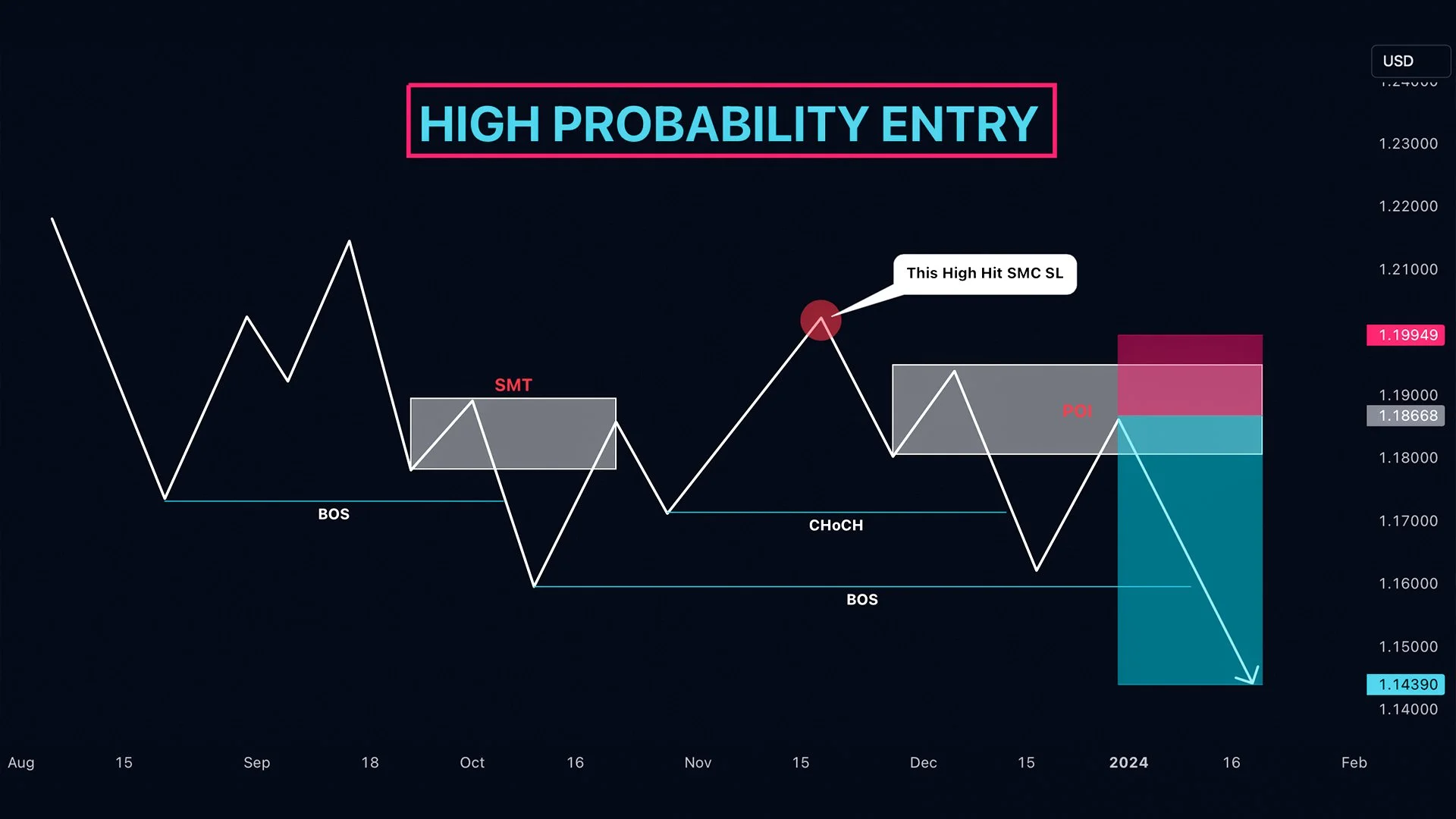
The Core Tenets of the Institutional Roadmap
SMC dictates that price movement is primarily driven by institutions manipulating price to gather liquidity (stop-loss orders) before moving the market aggressively to deliver profit. Mastering SMC involves identifying four key footprints left behind by the Smart Money:
1. Liquidity: The Institutional Fuel
In the world of SMC, liquidity is fuel. It is represented by the aggregation of resting stop-loss orders and pending limit orders that sit just above prominent swing highs (buy-side liquidity, or BSL) or below prominent swing lows (sell-side liquidity, or SSL).
The Trap: Retail traders are taught to place stop-losses at these obvious levels. Smart Money intentionally drives the price to these zones to trigger the stops (i.e., "sweep" the liquidity), providing the volume needed for their massive positions before reversing the price sharply. Trading SMC means looking for the sweep of liquidity, not trading the initial breakout.
2. Order Blocks (OB): The Institutional Fingerprint
An Order Block (OB) is the last up or down candle before a massive, aggressive move (known as Displacement). This candle represents the point where institutions placed their large initial orders, often running counter to the prevailing trend to gather positions before launching the true move.
The Entry: The OB acts as a high-probability area of supply or demand. SMC traders wait for the price to return to this precise zone (the "mitigation") to enter a trade, often aiming for the next liquidity pool.
3. Displacement and Market Structure Shift (MSS)
Displacement is the aggressive, impulsive move away from the Order Block. It confirms that Smart Money has entered the market with conviction. Following this displacement, traders look for a Market Structure Shift (MSS) or Change of Character (ChoCh).
The Confirmation: An MSS occurs when the price breaks the most recent significant high in an uptrend, or the most recent significant low in a downtrend. This is the institutional signal that the market trend has decisively changed.
4. Fair Value Gaps (FVG) / Imbalances
A Fair Value Gap (FVG), or imbalance, is a price inefficiency created during the sharp, quick Displacement move. It is a three-candle pattern where the high of the first candle and the low of the third candle do not overlap, leaving a price void.
The Magnet: SMC theory posits that price is highly likely to return to "fill" or "rebalance" this gap before continuing in the direction of the displacement. FVGs serve as powerful magnets for price and are often used in conjunction with an Order Block for high-precision entries.


Practical Application in Forex Trading
The application of SMC is particularly effective in the Forex market due to the high volume and deep liquidity, which makes institutional footprints easier to spot.
For traders focused on major currency pairs like EUR/USD or those looking at crosses like GBP/JPY, SMC provides clarity by filtering out low-quality trades:
Wait for the Setup: Instead of chasing breakouts, the trader waits for the price to intentionally sweep liquidity (e.g., a fake breakout of a high/low).
Confirm the Shift: Wait for the aggressive Displacement move that causes a Market Structure Shift (MSS). This confirms the institutional direction.
Define the Entry: Identify the Order Block left at the origin of the displacement and the associated Fair Value Gap (FVG).
Execute High-Probability Trade: Set a limit order at the OB/FVG area (the "point of interest" or POI), placing the stop-loss safely below/above the OB, and targeting the next obvious liquidity pool.
This structured, institutional approach to trading requires an advanced understanding of market dynamics—a core focus of specialized education like that offered by GME Academy (Global Markets Eruditio). By learning to read the market's hidden language, traders gain the confidence to hold positions that track the money flow of banks, leading to exceptionally high Reward-to-Risk Ratios.
Trading Like the Smart Money
Smart Money Concepts are not just another strategy; they represent a philosophy shift for retail traders. By focusing on how and why the USD or the Euro moves—rather than just where it is—you align your efforts with the powerful institutional forces that truly dictate price action.
This methodical tracking of liquidity and order flow provides the structure necessary for Forex Trading for Beginners to bypass common pitfalls and adopt the precision of institutional trading. It is the key to unlocking consistent profitability by avoiding the traps set for the majority.
Are You Ready to Stop Trading Against the Banks?
Understanding Smart Money Concepts requires dedicated training to accurately identify liquidity, Order Blocks, and Displacements in real-time. Don't let the banks continue to profit from your stop-losses.
Take the first step toward trading like an institution.
Join the GME Academy community today and sign up for our FREE Forex Workshop to master the fundamental logic of Smart Money flow and apply these high-precision concepts to your Forex Trading strategies!
