

The Pulse of the Market: Sentiment Analysis Using News and Social Data
In the financial landscape of 2026, "hard numbers" like GDP and earnings reports are no longer the only drivers of price action. We have entered the era of Sentiment Analysis, where the collective mood of the internet—captured from news headlines, viral tweets, and Reddit threads—is quantified into actionable trading signals.
At the GME Academy, we teach our students that while fundamental analysis tells you what should happen, sentiment analysis tells you what is happening in the hearts and minds of traders. In a world of instant communication, a single viral post can move billions of dollars faster than a central bank press release.
 https://images.squarespace-cdn.com/content/619b666b5842697e2af69258/a9d57b27-4fad-4532-874a-89133d6a85bc/P477.02.jpg?content-type=image%2Fjpeg
1. What is Financial Sentiment Analysis?
Sentiment analysis (or "opinion mining") uses Natural Language Processing (NLP) and Artificial Intelligence (AI) to analyze text data and determine the emotional tone behind it.
The "Polarity" Scale:
● Bullish (Positive): Optimism, "buy the dip," strong earnings, and upgrades.
● Bearish (Negative): Fear, "sell-off," regulatory crackdowns, and recession talk.
● Neutral: Factual reporting with no emotional bias.
2. News vs. Social Media: The Battle for Accuracy
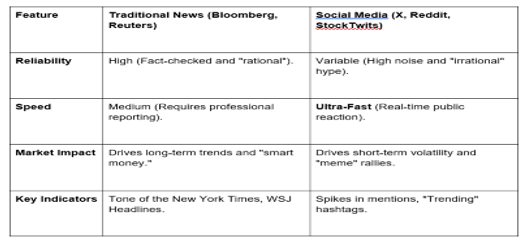
In 2026, research has shown a distinct split between how traditional news and social media influence the market.
 https://images.squarespace-cdn.com/content/619b666b5842697e2af69258/a9d57b27-4fad-4532-874a-89133d6a85bc/P477.02.jpg?content-type=image%2Fjpeg
The 2026 Trend: Studies (like the SAFFM model) indicate that social media sentiment exerts a more consistent and immediate influence on big tech stocks like Microsoft and Amazon, while traditional news remains the "gold standard" for macro-economic moves.
3. How Algorithmic Trading Uses Sentiment
Modern algorithmic systems (like the CAB-LSTM) don't just look at price charts. They use sentiment as a "Gatekeeper":
Sentiment-Aware Forecasting: If an algorithm sees a "Golden Cross" (bullish signal) but news sentiment is -0.80 (Extreme Fear) due to a geopolitical event, the bot will refrain from buying.
Event-Driven Trading: Bots are programmed to scan for "High-Impact" keywords. If "Central Bank Hike" appears across 50 major news sources simultaneously, the bot executes a "short" position in milliseconds.
Contrarian Signals: Professional traders look for Extreme Sentiment. If 95% of social media is "Extreme Bullish," it often signals that the market is overbought and a reversal is coming.
4. Top Sentiment Analysis Tools for 2026
Whether you are a retail trader or a large enterprise, these are the tools currently dominating the market:
For Enterprise: IBM Watson NLU and Google Cloud Natural Language API provide high-level multilingual sentiment detection using transformer models.
For Brand & Sentiment Tracking: Brandwatch and Meltwater are the leaders in monitoring real-time "share of emotion" across forums and news outlets.
For Retail Traders:Stocktwits and StockGeist.ai focus specifically on market "mood" and real-time investor conversations
The GME Academy Analysis: "Trade the Mood, Not the News"
At Global Markets Eruditio, we advise our traders to be wary of "Noise." Social media is often filled with "irrational" sentiment driven by herd mentality.
Your 2026 Sentiment Strategy:
Filter for Authority: Follow "verified" analysts and CEOs on X (Twitter). Their sentiment carries more weight than 1,000 anonymous bots.
Look for Divergence: If the price is going up but social media sentiment is dropping, the rally may be running out of steam.
Combine with Technicals: Never trade sentiment alone. Use it to confirm a technical setup you’ve already found on your charts.
Join our FREE Forex Workshop at Global Markets Eruditio!
Want to learn how to use FinBERT or VADER to scan the news for you? We’ll show you how to build a simple "Sentiment Dashboard" to give you an edge in the USD/PHP and Equity markets.
