

The Engines of Equity: SSS, GSIS, and Pag-IBIG in Philippine Financial Flows
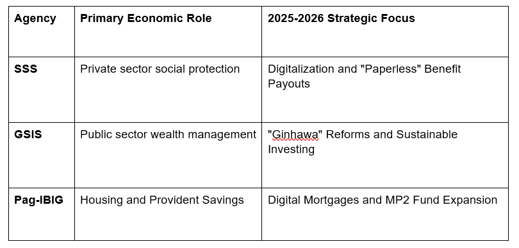
In the complex machinery of the Philippine economy, three institutions act as the primary "pumps" of domestic capital: the Social Security System (SSS), the Government Service Insurance System (GSIS), and the Home Development Mutual Fund (Pag-IBIG). Together, they manage over ₱4 trillion in assets, directing a constant stream of liquidity into the financial markets, the housing sector, and the pockets of millions of Filipinos.
As of February 2026, their role has evolved from simple "pension funds" to sophisticated institutional investors that stabilize the national economy during global volatility.
 https://images.squarespace-cdn.com/content/619b666b5842697e2af69258/a9d57b27-4fad-4532-874a-89133d6a85bc/P477.02.jpg?content-type=image%2Fjpeg
1. The Mechanics of Inflow: Aggregated Savings
These agencies function as a form of forced national savings. Every month, millions of employees and their employers remit contributions, creating a predictable and massive "inflow" of cash.
SSS (Private Sector): With record-breaking revenues of over ₱350 billion annually, SSS pools the micro-contributions of private workers, OFWs, and the self-employed.
GSIS (Public Sector): Managing assets for 2.5 million government workers, GSIS hit a record ₱1.92 trillion in total assets by late 2025.
Pag-IBIG (Housing/Provident): In 2024, Pag-IBIG’s asset base breached the ₱1 trillion mark for the first time, driven by its popular MP2 voluntary savings program.
2. Directing the Flow: Investment and Market Liquidity
What happens to the money once it's collected? It doesn't sit in a vault; it flows back into the economy to generate returns that ensure "Fund Life."
A. The Stock Market (PSEi) Backbone
The Philippine Stock Exchange (PSE) has recently pushed for a revival of "Stock Loan Programs" for SSS and GSIS members. By 2026, these pension funds will be encouraged to act as "Anchors" of the market.
Institutional Support: SSS and GSIS are among the largest domestic holders of blue-chip stocks (like Meralco, SM, and BPI). When foreign investors exit the Philippines, these funds often provide the "buying floor" that prevents a total market crash.
Capital Market Injection: New initiatives in 2026 are exploring "broker-led models" where members can borrow against their contributions specifically to invest in the stock market, injecting much-needed liquidity into the PSEi.
B. Government Debt (The Sovereign Cushion)
A significant portion of SSS and GSIS funds is invested in Government Bonds (T-Bills and JGBs equivalent). By buying government debt, these agencies essentially fund the national budget—building the bridges, schools, and hospitals that drive GDP.
3. The Multiplier Effect: Loans and Housing
The most visible way these funds affect "Financial Flows" is through direct lending to members.
The Housing Engine (Pag-IBIG): Pag-IBIG is the single largest source of affordable home financing in the country. By providing 30-year loans at rates as low as 3%, it fuels the real estate and construction industries—two major drivers of Philippine employment.
Short-Term Liquidity (SSS/GSIS Loans): Salary, calamity, and multi-purpose loans provide a "safety valve" for the economy. In times of inflation or crisis, these loans inject cash directly into household consumption, keeping the wheels of local commerce turning.
 https://images.squarespace-cdn.com/content/619b666b5842697e2af69258/a9d57b27-4fad-4532-874a-89133d6a85bc/P477.02.jpg?content-type=image%2Fjpeg
4. The Macro View: Stability and Trust
As BSP Deputy Governor Lyn Javier noted earlier this year, "Public trust is the foundation of banking." This applies equally to these social funds.
Fund Sustainability: Through 2025, reforms like the SSS Pension Reform Program and GSIS’s prudent investment strategies have extended the "Fund Life" of these agencies through 2058 and beyond.
Counter-Cyclical Force: When the private banking sector tightens credit, SSS and Pag-IBIG often maintain or even expand their lending, acting as a "stabilizer" that prevents the economy from stalling.


The GME Academy Analysis: "Watch the Institutional Giant"
At Global Markets Eruditio, we teach that the "Flow of Funds" is the heartbeat of any market. For a trader or investor in the Philippines, watching the investment movements of SSS and GSIS is critical.
How to Position Your Portfolio:
Follow the Giants: When GSIS increases its exposure to a specific sector (like Infrastructure or Tech), it often signals long-term stability in those stocks.
Monitor the MP2: High participation in the Pag-IBIG MP2 program signals a high "Savings Rate" among the middle class, which can take liquidity out of the stock market but provides long-term capital for housing.
Join our FREE Philippine Macroeconomics Workshop
Learn how to track the Quarterly Financial Reports of SSS and GSIS to predict market trends. We’ll show you how "Pension Fund Buying" affects the PSEi and how to align your personal investments with the national "Flow of Funds."
