

The Internal Revenue Rally: US Tax Season and Dollar Demand
As we move through February 10, 2026, the US financial landscape is bracing for one of its most predictable, yet potent, seasonal shifts: the Individual Income Tax Filing Season. While most Americans view April 15th as a deadline for paperwork, global currency traders at the GME Academy view it as a major catalyst for liquidity and US Dollar (USD) demand.
In 2026, this season is particularly unique due to the "Refund Surge" triggered by the One Big Beautiful Bill Act (OBBBA) passed in late 2025. This legislation retroactively increased deductions for the 2025 tax year, creating a scenario where billions of dollars are being moved, converted, and redistributed across the globe.
1. The Two-Phase Dollar Cycle
The US Tax Season impacts the dollar in two distinct phases: the Repatriation Phase and the Refund/Spending Phase.
Phase 1: Repatriation & Payment (The Bullish Lead-up)
In the weeks leading up to the April 15, 2026, deadline, corporations and high-net-worth individuals must ensure they have enough "Greenbacks" to settle their tax liabilities with the Treasury.
The Flow: For entities with global operations, this often requires selling foreign assets or currencies (like the EUR, JPY, or GBP) to buy USD.
The Impact: This creates a natural "buy-side" pressure on the DXY (Dollar Index). Historically, the USD tends to find a seasonal floor in late Q1 as these payment flows intensify.
Phase 2: The Refund Surge (The Consumption Kick)
Because the OBBBA backdated tax cuts to early 2025, the IRS is issuing a "bumper crop" of refunds in February and March 2026.
Stimulus-Like Effect: Analysts at J.P. Morgan estimate that these extra refunds amount to roughly 0.27% of GDP.
The Logic: Unlike tax payments (which remove liquidity), tax refunds inject cash directly into the pockets of consumers. This boosts retail sales and domestic growth, which can paradoxically support the Dollar by keeping the Federal Reserve from cutting interest rates too quickly.
2. 2026 Policy Wildcards: Tariffs and the Fed
The "Tax Season Rally" of 2026 is facing stiff competition from two other macro forces:
Tariff Expectations: Persistent talk of new trade barriers has kept inflation expectations sticky at 3%. This puts a "floor" under the USD, as traders bet the Fed will keep rates elevated.
The "Sugar Rush" Inflation: If the refund surge leads to a spike in consumer spending, the Fed may delay its planned May 2026 rate cut. This "hawkish delay" is a primary reason the USD/PHP has remained resilient near the ₱57.50 level despite global softening.
3. Safe-Havens and the "April Apex"
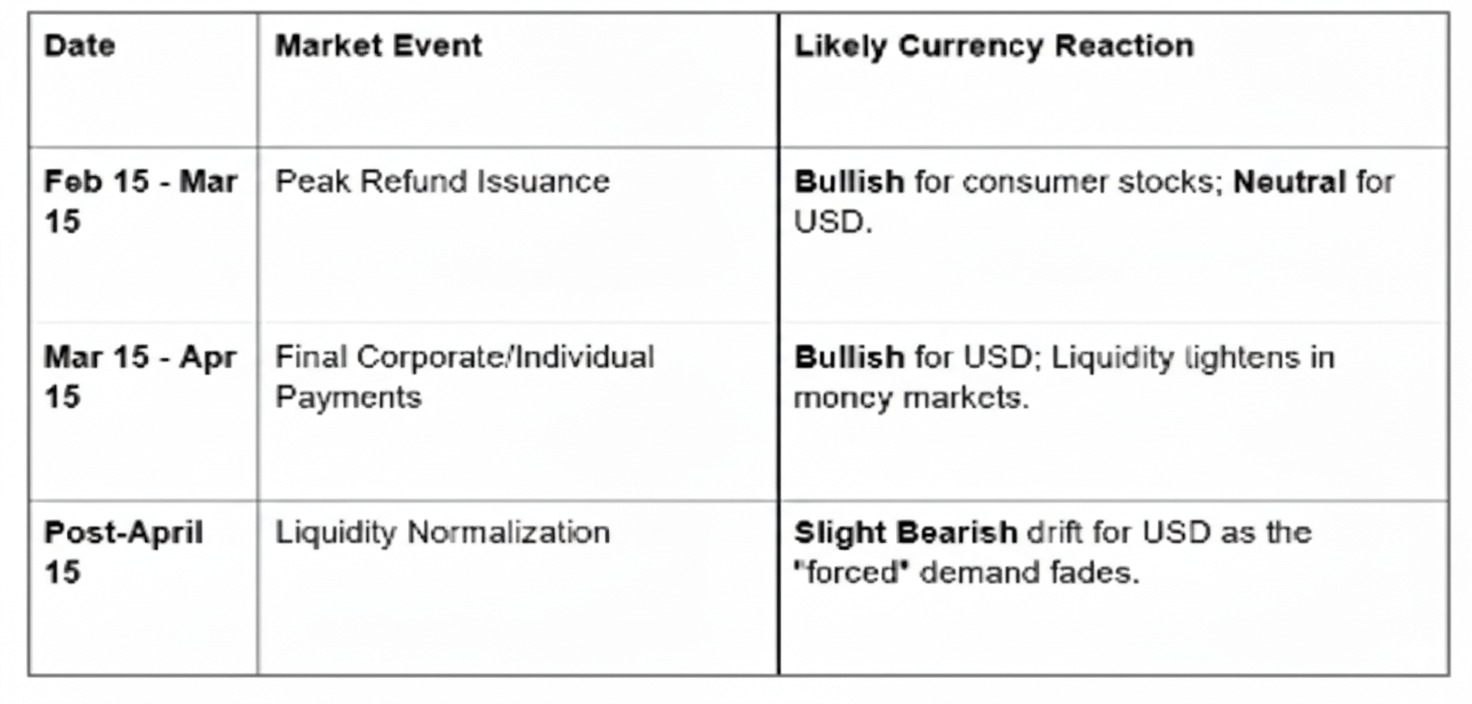
Trading Insight: Watch the US Treasury Cash Balance. When the Treasury's account at the Fed swells in mid-April, it literally sucks liquidity out of the banking system, often causing a short-term spike in the value of the Dollar.


The GME Academy Analysis: "Trading the Refund Flow"
At Global Markets Eruditio, we analyze the tax season as a "Liquidity Event" that creates reliable patterns for those watching the charts.
Trader's Takeaway for 2026:
The "Value" Play: Historically, US large-cap "Value" equities tend to outperform "Growth" when the Dollar softens slightly in the early refund season (February).
Watch the DXY: If the Dollar Index breaks above its 104.50 resistance in late March, it’s a sign that the "tax payment" demand is outweighing the "refund" liquidity.
PHP Strategy: For Filipinos, the April tax deadline in the US often coincides with a period of lower remittances after the Easter holidays. This "double-whammy"—high USD demand for taxes and low PHP supply—can lead to a brief period of Peso weakness in mid-April.
Join our FREE Forex Workshop at Global Markets Eruditio!
Is the 2026 "Refund Surge" enough to prevent a recession? We’ll break down the US Treasury TIC data and show you how to use seasonal tax cycles to time your entries in the EUR/USD and USD/JPY.
