

The Great Hesitation: US Job Openings Sink to 5-Year Low in December JOLTS Report
The U.S. labor market ended 2025 on a significantly cooler note than many anticipated. According to the Job Openings and Labor Turnover Survey (JOLTS) released by the Bureau of Labor Statistics on February 5, 2026, the number of unfilled positions dropped to 6.5 million in December.
This figure represents a sharp decline of 386,000 from the previous month and is nearly a million lower than the same time last year. For market analysts, this is the clearest signal yet of a "low-hire, low-fire" economy—a delicate state where employers are holding onto their current staff but have largely stopped searching for new ones.
1. Key Metrics: A Snapshot of Decelerating Demand
The headline job openings number (6.5 million) fell well below the market expectation of 7.2 million, triggering immediate volatility in the currency markets.
Job Openings Rate: Edged down to 3.9%.
The Quit Rate: Held steady at 2.0% (3.2 million). This is a crucial indicator of worker confidence; a flat or falling quits rate suggests that employees no longer feel as certain about finding a better-paying job if they leave their current one.
Layoffs & Discharges: Remained relatively low at 1.8 million, showing that while companies aren't hiring, they aren't yet in "panic-firing" mode.
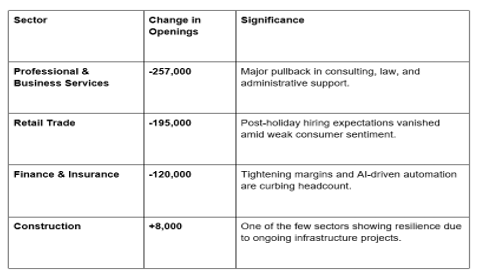
2. Sector Analysis: Where the Openings Vanished
The decline was most aggressive in sectors that typically drive the professional economy. These "white-collar" industries are often the first to scale back in the face of economic uncertainty.
3. Revisions: The November "Downward Drift."
Crucially, the BLS also revised its November data significantly downward. The previously reported 7.1 million openings for November were corrected to 6.9 million. These revisions suggest that the labor market was actually weaker throughout the fourth quarter of 2025 than initial reports indicated.
4. Forex and Market Impact: The Dollar's Dilemma
For USD traders, the JOLTS "miss" was a bearish signal.
Fed Policy: Federal Reserve Chair Jerome Powell has frequently cited the Job Openings to Unemployed Ratio as a key metric. With openings falling while unemployment sits at 4.4%, the ratio has narrowed to roughly 0.9:1. This imbalance (more seekers than jobs) gives the Fed more room to consider rate cuts in the first half of 2026.
DXY Reaction: The U.S. Dollar Index (DXY) fell below the 97.0 level shortly after the 10:00 AM release, as investors priced in a more dovish central bank.
Gold & Safe Havens: Gold saw a modest boost as the weak data revived fears of a potential recession in late 2026.


The GME Academy Analysis: "Trade the Tightening"
At Global Markets Eruditio, we analyze JOLTS not as a single number, but as a map of corporate intent. When Professional Services job openings crater as they did this month, it signals that the "brains" of the economy are bracing for a slowdown.
How to Position Your Portfolio:
Forex: If the NFP (Non-Farm Payrolls) report next week confirms this JOLTS weakness, the EUR/USD could test the $1.20 barrier.
Economic Strategy: The "Great Resignation" is officially over. In this "low-quit" environment, wage growth is expected to slow down, which will eventually help pull core inflation toward the Fed's 2% target.
Join our FREE JOLTS Deep-Dive Workshop
Learn how to use the Quits Rate to predict future wage-price inflation. We will break down the latest BLS tables and show you how to identify the next sector likely to see a layoff surge.
