

Is Your Safety Net Too Small? Why Volatility-Based Stops Are the Secret to Longevity
Many traders enter a position on a promising currency pair, only to see their stop-loss hit by a momentary price spike before the market ultimately moves in their favor. It’s a frustrating experience known as being "stopped out" by market noise. For those just starting with Forex Trading for Beginners, the natural reaction is to move the stop further away, but without a mathematical basis, this only increases risk.
The truth is that the market does not care about your "50-pip rule" or your personal risk tolerance in a vacuum. It moves based on volatility. To survive and thrive in Forex, you must learn to set your exit points based on how much the market is actually breathing.
 https://images.squarespace-cdn.com/content/619b666b5842697e2af69258/a9d57b27-4fad-4532-874a-89133d6a85bc/P477.02.jpg?content-type=image%2Fjpeg
The Flaw of Fixed Stop-Losses
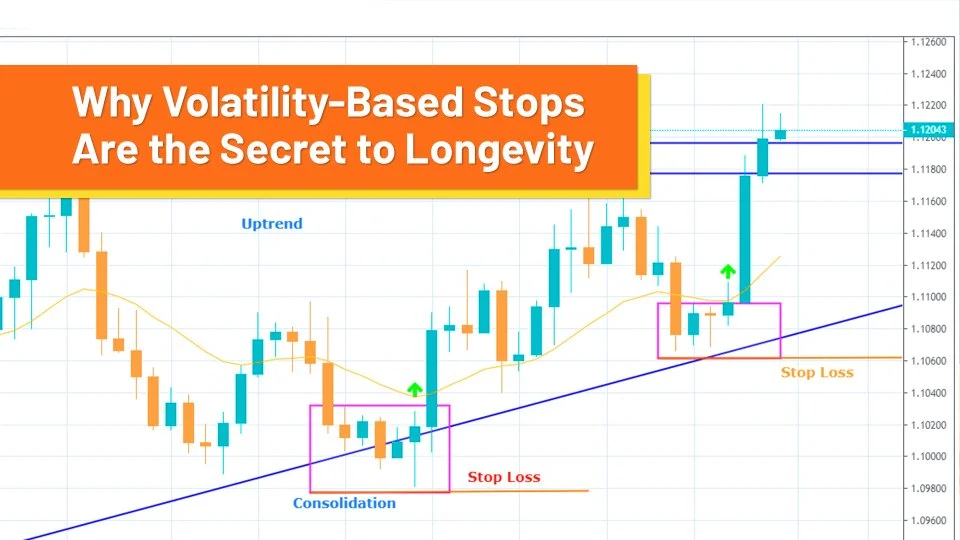
A fixed stop-loss is like wearing a medium-sized coat regardless of whether you are in a tropical breeze or an arctic blizzard. In a quiet market, a 30-pip stop might be more than enough. However, during high-impact news involving the US Dollar (USD) or the Canadian Dollar (CAD), that same 30 pips could be wiped out in seconds by standard price fluctuations.
By using volatility-based stops, you ensure that your "safety net" is wide enough to withstand the current weather of the market while remaining tight enough to protect your capital.
Introducing the ATR: Your Volatility Compass
The most effective tool for measuring this "market breadth" is the Average True Range (ATR). Developed by J. Welles Wilder Jr., the ATR doesn't tell you which way the price is going; it tells you how much it is moving.
If the ATR for EUR/USD is 0.0080 (80 pips), it means that, on average, the pair moves 80 pips per candle. If you place a stop-loss only 20 pips away, you are essentially betting that the market will behave significantly differently than it has for the last 14 periods. Mathematically, you are likely to be stopped out by pure chance.
How to Calculate Your Volatility Stop
To implement this in your Forex Trading, follow this simple formula:
Check the ATR: Look at the current ATR value on your timeframe (usually the 14-period).
Apply a Multiplier: Most professional traders use a multiplier of 1.5 X to 3 X the ATR.
Set the Level: * For Longs: EntryPrice - (ATR X Multiplier)
For Shorts: EntryPrice + (ATR X Multiplier)
For example, if you are trading GBP/JPY and the ATR is 100 pips, a 2 X multiplier means your stop-loss should be 200 pips away. This gives the "Dragon" (as GBP/JPY is often called) room to swing without ending your trade prematurely.
Adapting to Different Economies
Volatility isn't uniform. A single-economy event, such as a US Dollar interest rate hike, can cause a massive spike in USD pairs. Conversely, cross-economy pairs like EUR/USD might experience "offsetting" volatility if both regions release data simultaneously.
Educational institutions like Global Markets Eruditio emphasize that understanding the why behind price movement is just as important as the how. By mastering volatility, you transition from a gambler hoping for the best to a technician managing probabilities. This is the cornerstone of the GME Academy philosophy: empowering traders with the logic of the institutional world.


Consistency is the Key to Success
The beauty of this method is that it forces you to adjust your position size. When volatility is high (large ATR), your stop-loss is wider, meaning you should trade fewer lots to keep your total dollar risk the same. When the market is quiet, your stops can be tighter, allowing for larger positions. This keeps your risk-per-trade constant regardless of market conditions.
Take the Next Step in Your Education
Stop guessing where to put your stops. If you want to refine your strategy and learn how to navigate the complex world of Forex Trading with professional-grade tools, we invite you to take your knowledge further.
Ready to master the markets?
Don't let market noise dictate your success. Join our FREE Forex Workshop today and learn the exact frameworks used by veteran traders to protect their capital and scale their profits.
